About Saxidomus gigantea (Deshayes, 1839)
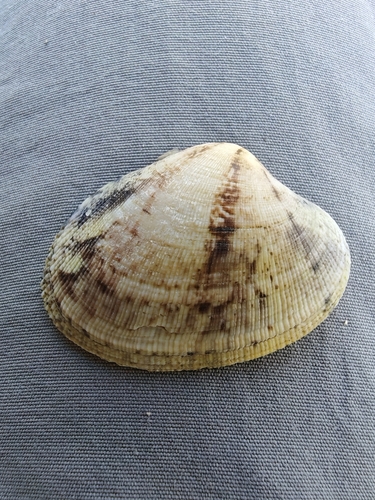
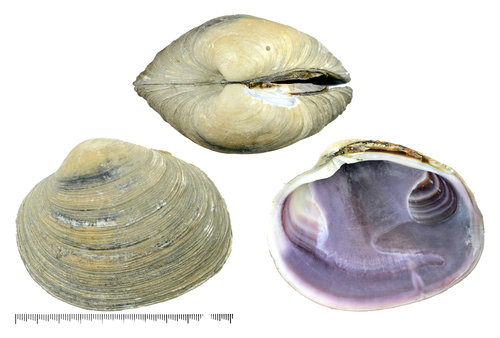
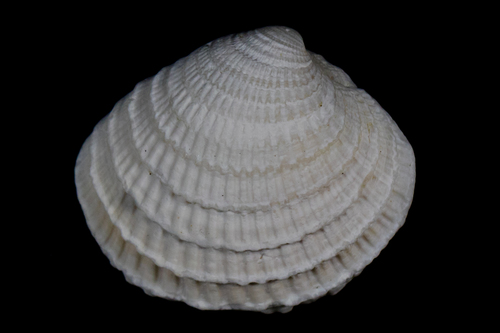
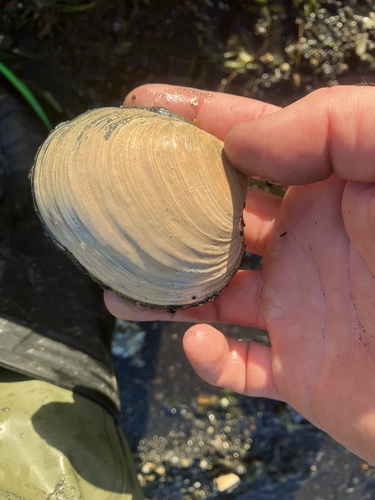
This large clam can live for over twenty years, and reaches a maximum length of 15 cm (6 in). Smaller individuals of this species are nearly as tall as they are long. The umbones are positioned at an angle greater than 110°, and the external ligament that connects the two valves is black. The oval valves have no radial ridges, but are marked with clear, well-defined concentric sculpted rings. Each valve holds three cardinal teeth. The outer surface of the shell is generally white, though it can be stained reddish-brown by iron sulfide from surrounding sediment. The inner shell surface is smooth, matte white, and displays a pallial line, a pallial sinus, and two equally sized adductor muscle scars. The clam's united siphons are around 4 cm (1.6 in) long and have black tips. Saxidomus gigantea is native to shallow waters of the northeastern Pacific Ocean. Its range stretches from the Bering Sea and Aleutian Islands south to San Francisco Bay, California, though it is rarely found south of Humboldt Bay. It lives buried in soft sediments including sand, muddy sand, and gravel, and occurs from the low intertidal zone down to depths of around 40 m (130 ft). This clam burrows into soft sediment, sometimes reaching depths of 35 cm (14 in) below the sediment surface. It is a filter feeder: when feeding, it extends its siphons to pull in a respiratory water current, removes phytoplankton and other planktonic organic particles, then expels the remaining water. Small pea crabs like Pinnixa faba sometimes live symbiotically inside the clam's mantle cavity. Predators of this clam include the larger Dungeness crab, Lewis's moon snail, sunflower sea stars, mottled stars, and sea otters.