About Saxicola stejnegeri (Parrot, 1908)
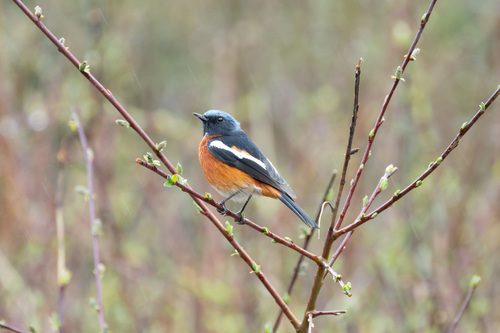
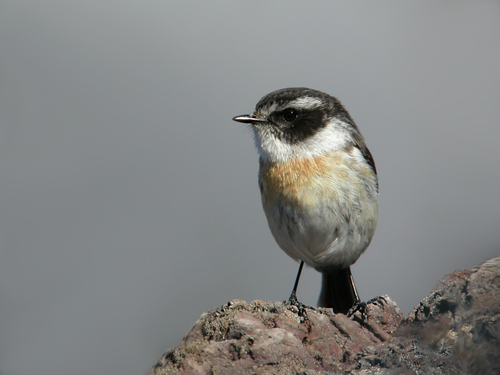
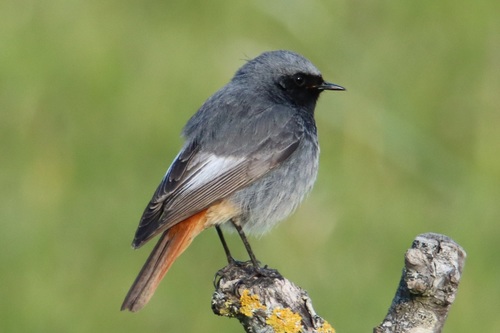
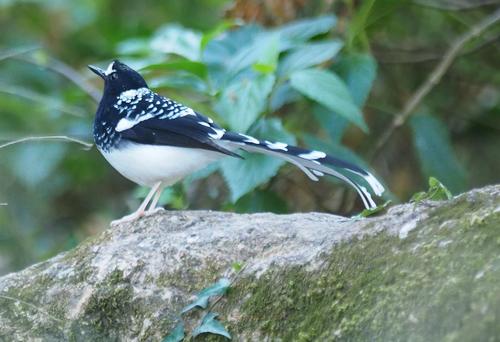
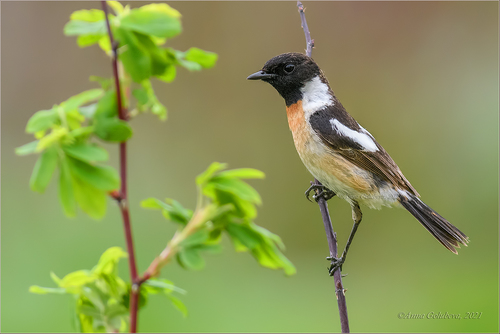
This species, the Siberian stonechat, resembles its close relative the European stonechat (S. rubicola), but is typically darker on its upperparts and paler on its underparts. It has a white rump, whiter underparts overall, and less orange color on the breast. Breeding-plumage males have entirely black upperparts and head, with no brownish tones present in the European stonechat, plus a prominent white collar, white scapular patch, and white rump, with only a small restricted patch of orange on the throat. Females have pale brown upperparts and head, white patches on the neck that do not form a full collar, and a pale, unstreaked pinkish-yellow rump. Winter-plumage males are intermediate in appearance between breeding males and females, and have a supercilium that looks like that of the whinchat (S. rubetra). They can be distinguished from both whinchats and female Siberian stonechats by their full white collar. When viewed at close range, the primary remiges of this species are distinctly longer than those of S. rubicola. This longer primary remige trait closely resembles the whinchat; like S. maurus, this species is adapted for long-distance migration. Males produce a clicking call that sounds like two small pebbles knocked together. The song of the Siberian stonechat is high-pitched and twittering, similar to that of the dunnock (Prunella modularis), an unrelated passeridan songbird in the Passeroidea. There are five or six subspecies of this species. S. m. maurus matches the description above, while the distinct but similar S. m. stejnegeri occurs across northern and central Asia. Southern subspecies—S. m. variegatus found west of the Caspian Sea, S. m. armenicus ranging from eastern Turkey to Iran, S. m. indicus from the Himalaya, and the Turkestan stonechat S. m. przewalskii from southwest China—are distinguished by larger white areas in their plumage. In the past, S. maurus was usually grouped into S. torquatus as part of the "common stonechat", but today this scientific name is restricted to the African stonechat. Analysis of mtDNA cytochrome b sequences and nDNA microsatellite fingerprinting data, while not entirely unambiguous, when combined with evidence from morphology, behavior, and biogeography, supports recognizing this bird as a distinct species. The European stonechat is its western sister species in the Eurasian lineage of stonechats. Their ancestors diverged during the Late Pliocene or Early Pleistocene, roughly 1.5 to 2.5 million years ago at the start of the Quaternary glaciation. The breeding range of the Siberian stonechat covers most of temperate Asia, stretching from around 71°N in Siberia south to the Himalaya and southwest China, and west to eastern Turkey and the Caspian Sea region. It also breeds in the far northeast of Europe, mainly in Russia, and occasionally occurs as far west as Finland. As a migratory bird, it winters from southern Japan south to Thailand and India, and west to northeast Africa. During migration, small individuals reach as far west as western Europe, and in rare exceptional cases have been found as far east as Alaska in North America.