About Saxicola rubicola (Linnaeus, 1766)
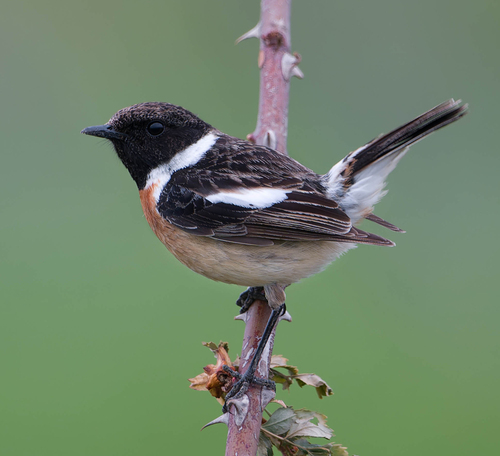
The European stonechat, Saxicola rubicola (Linnaeus, 1766), measures 11.5–13 cm (4.5–5.1 in) in length and weighs 13–17 g (0.46–0.60 oz), making it slightly smaller than the European robin. Both males and females have characteristically short wings, which are shorter than the wings of the more migratory whinchat and Siberian stonechat. In summer, breeding males have black upperparts and a black head, paired with an orange throat and breast, and a white belly and vent. Males also have a white half-collar on the sides of the neck, a small white scapular patch on the wings, and a very small, often black-streaked white patch on the rump. Females have brown upperparts and head, with no white patches on the neck, rump, or belly; these areas are marked with dark brown streaks over a paler brown base. The only white marking on females is the scapular patch on the wings, which is often buffy-white. This species has two recognized subspecies, whose color intensity follows Gloger's rule. S. r. rubicola is paler with larger white patches, and occurs in drier European continental and Mediterranean climates. S. r. hibernans is darker brown with less white, and lives in the humid Atlantic oceanic climate. The two subspecies intergrade broadly across their overlapping range, which extends from southeastern England south through France and Spain, and many individuals cannot be assigned to either subspecies. Extreme examples of S. r. rubicola from the driest southern areas of its range, such as the Algarve and Sicily, are particularly pale with a large white rump, and can closely resemble the Siberian stonechat in appearance. Nuclear DNA microsatellite fingerprinting shows only a very small degree of genetic separation between the two subspecies. A study of the size of the white wing patch and its components of variation, conducted on a Spanish population of S. r. rubicola, found that this trait is dynamic and changes throughout an individual’s life, but is also consistent at the individual level. The white wing patch may carry information about both the long-term quality and current state of an individual. The male's song is high and twittering, similar to the song of a dunnock. Both sexes produce a clicking call that sounds like stones knocking together. European stonechats breed in heathland, coastal dunes, and rough grassland that has scattered small shrubs, bramble, open gorse, tussocks, or heather. They are either short-distance migrants or non-migratory. A portion of the population, particularly birds from northeastern parts of the range where winters are colder, moves south to overwinter in southern Europe and across a wider area of North Africa.