About Saxicola caprata (Linnaeus, 1766)
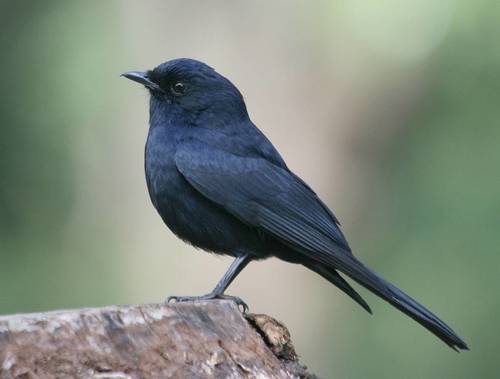
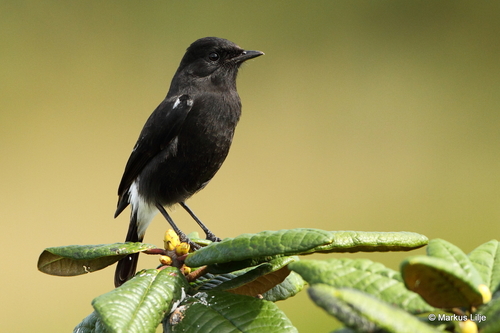
The pied bush chat (Saxicola caprata) measures about 13 cm (5.1 in) in length, making it slightly smaller than the Siberian stonechat (Saxicola maurus). It shares the Siberian stonechat’s dumpy body structure and upright standing stance. Male pied bush chats are mostly black, with white markings on the rump, a patch on the wing, and the lower belly; their irises are dark brown, and their bills and legs are black. Females are drab brown with faint streaking. Juveniles have a scaly pattern on their undersides, with dark upperparts that match the females. Multiple distinct geographic populations are recognized as subspecies. The nominate subspecies S. c. caprata is found on Luzon and Mindoro in the Philippines. S. c. rossorum, described by Hartert in 1910, occurs from northeastern Iran and south-central Kazakhstan south to Afghanistan and Baluchistan, and migrates to southwestern Asia, with vagrants recorded in Arabia and Israel. It has more white on its underbelly than S. c. bicolor, and is not always recognized as a valid subspecies. S. c. bicolor, named by Sykes in 1832, ranges across southeastern Iran, Afghanistan, Pakistan, and northern India, and migrates to central India, and possibly southern India. S. c. burmanicus, described by Stuart Baker in 1922, is found from peninsular India east to Myanmar and southern China (southern Sichuan and Yunnan), and south to Thailand and Indochina. On this subspecies, the white abdominal marking is restricted to the area near the vent. S. c. nilgiriensis, named by Whistler in 1940, is restricted to the Western Ghats and the Nilgiri Hills. S. c. atratus, described by Blyth in 1851, is found only in Sri Lanka, and has a larger bill than other subspecies. Several additional subspecies come from isolated island populations. S. c. randi, described by Parkes in 1960, occurs in the central Philippines, on Panay, Negros, Cebu, Bohol, and Siquijor. S. c. anderseni, named by Salomonsen in 1953, is found on Leyte and Mindanao in the Philippines. S. c. fruticola, described by Horsfield in 1821, ranges from Java east to Flores and Alor. S. c. francki, named by Rensch in 1931, is restricted to the Sumba Islands. S. c. pyrrhonotus, described by Vieillot in 1818, is found in the eastern Lesser Sundas, on Wetar, Kisar, Timor, Savu, and Roti. S. c. albonotatus, described by Stresemann in 1912, occurs in Sulawesi (excluding the northern peninsula) and Salayer Island. S. c. cognatus, named by Mayr in 1944, is found only on Babar Island. S. c. belensis, described by Rand in 1940, occurs in west-central New Guinea. S. c. aethiops, described by P. L. Sclater in 1880, is found in northern New Guinea and the Bismarck Archipelago. S. c. wahgiensis, named by Mayr & Gilliard in 1951, occurs in east-central and eastern New Guinea. The pied bush chat is closely related to the European-African stonechat complex. Populations of S. c. fruticola from Moyo Island, Indonesia are genetically well differentiated from S. c. fruticola specimens from Lembata Island, with an estimated divergence around 360,000 years ago. S. c. pyrrhonotus is found in West Timor, Indonesia. Recorded local names for the species include Kala pidda in Hindi, Shyama in Gujarati, Kavda gapidda in Marathi, Kallu kuruvi in Tamil, and Kampa nalanchi in Telugu. The Fore people of New Guinea call the species pobogile. Historically, pied bush chats were popular cage birds in Bengal, and they are still traded in local bird markets in parts of Southeast Asia. The pied bush chat is a resident breeding species across tropical southern Asia, ranging from the Greater Middle East through the Indian subcontinent, east all the way to Indonesia. It colonized Papua New Guinea around 1950. It inhabits open environments including scrub, grassland, and cultivated land. Some populations are partially migratory. One ringed individual of the subspecies rossorum has been recovered in Israel. Populations in India also show seasonal movements, though their exact patterns are not clear. The subspecies bicolor occurs in peninsular India during the winter. On the western coast at Karwar, the species is recorded from October to May, and is not seen during the rainy season. It is reported to be absent from Baroda district, Gujarat from April to September. Claud Buchanan Ticehurst noted that the species is a summer visitor to Baluchistan, departing in October, and that birds from Baluchistan are indistinguishable from rossorum from Turkestan. The species’ main breeding season runs from February to August, with a peak between March and June. Males sing from exposed, prominent perches. Their whistling call is similar to that of the Indian robin, and has been transcribed as "we are tea for two", with the word "tea" sung at a higher pitch. The nest is built inside a hole in a wall or a similar location, lined with grass and hair. Clutches contain between two and five eggs. In one study, paired males did not reduce their dawn singing behavior when their mates were trapped and temporarily removed from their territory. This suggests that males use dawn choruses to manage social relationships with neighboring males and mark established territory boundaries. The eggs are small, broadly oval, with a pale bluish-white or pinkish base color, and speckles and blotches concentrated near the broader end. They measure approximately 0.67 by 0.55 inches (1.7 by 1.4 cm). Incubation is performed mainly by the female, and lasts 12 to 13 days. Brood parasitism by the common cuckoo (bakeri race) is common in Shan State, Burma; cuckoos visit pied bush chat nests at dusk, remove one host egg, and quickly lay their own egg in its place. During the breeding season, males perform courtship displays, splaying their tails, fluttering, and puffing up their white scapular feathers. The pied bush chat is an insectivorous species, and like other chats hunts from a prominent low perch. It has been recorded feeding on pyralid moths and whitefly. Nematode parasites from the genus Acuaria have been found in this species. Adult pied bush chats have few predators, but the greater false vampire bat (Megaderma lyra) and wintering short-eared owls (Asio flammeus) have been recorded preying on them.