About Saxegothaea conspicua Lindl.
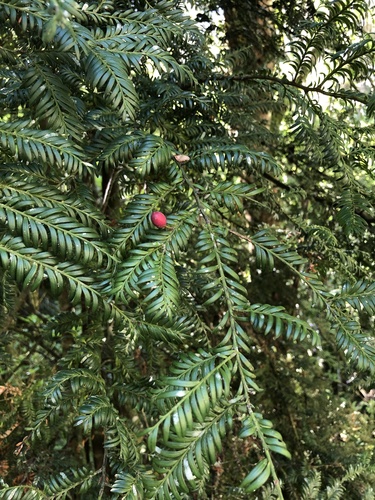
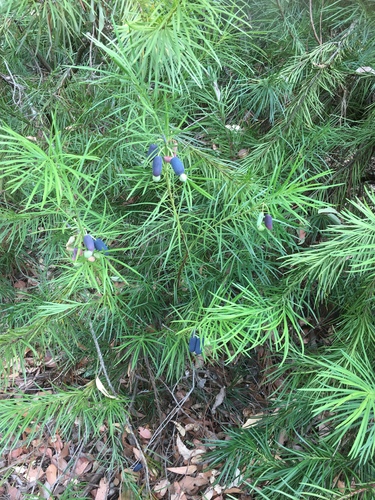
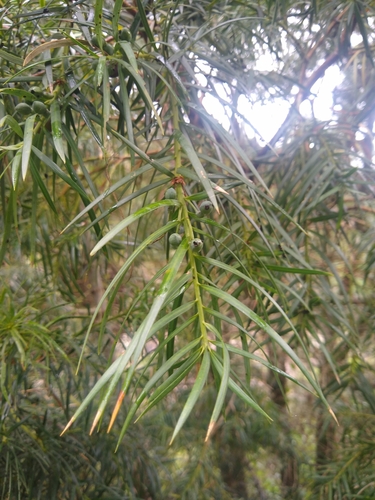
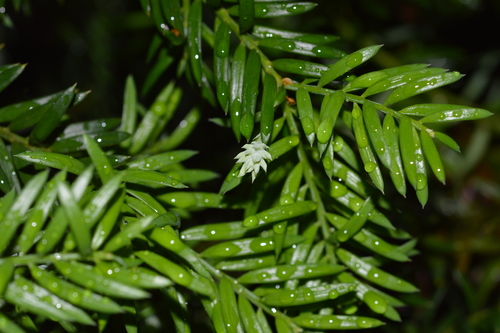
The genus Saxegothaea contains only one species, Saxegothaea conspicua. This is a conifer belonging to the podocarp family Podocarpaceae, and it is native to southern South America. It grows in Chile and Argentina between 35° and 46° South latitude. In its northernmost natural range, it grows at elevations of 800 to 1000 m (2600–3300 ft) above sea level, while in the southern part of its range it grows at sea level. The species is most commonly called by its genus name, and is sometimes referred to as female maniu (a translation of its Spanish name) or Prince Albert's yew. In South America, it is called mañío hembra or maniú hembra. The genus name Saxegothaea honors Franz August Carl Albert Emanuel von Sachsen-Coburg und Gotha (1819–1861), who was Queen Victoria's consort from their marriage on 10 February 1840 until his death in 1861. When John Lindley published the species in J. Hort. Soc. London volume 6, on page 258 in 1851, he wrote: "This remarkable plant, to which His Royal Highness Prince Albert has been pleased to permit one of his titles to be given, and which will probably rank among the most highly valued of our hardy evergreen trees, is a native of the mountains of Patagonia, where it was found by Mr. William Lobb, forming a beautiful tree 30 feet high." Saxegothaea conspicua is a slow-growing, long-lived evergreen tree that reaches 15–25 m (50–80 ft) in height, with a trunk up to 1 m in diameter. Its bark is thin, flaky to scaly, and dark purple-brown. Its leaves are arranged in an irregular spiral; they are lanceolate, 1.5–3 cm long and 2 mm broad, fairly hard with a prickly spine tip, dark green on the upper surface, and marked with two glaucous blue-white stomatal bands on the lower surface. Its cones are 1 cm long, with 15-20 soft scales; usually only 2-4 scales on each cone are fertile, each bearing a single seed 3 mm in diameter. Saxegothaea conspicua is endemic to the Valdivian temperate rain forests of southern Chile and adjacent parts of Argentina, where it is generally found growing alongside Pilgerodendron uviferum and Fitzroya cupressoides. Its wood is good quality, and is used to make furniture and barrels.