About Saurothera merlini Orbigny, 1839
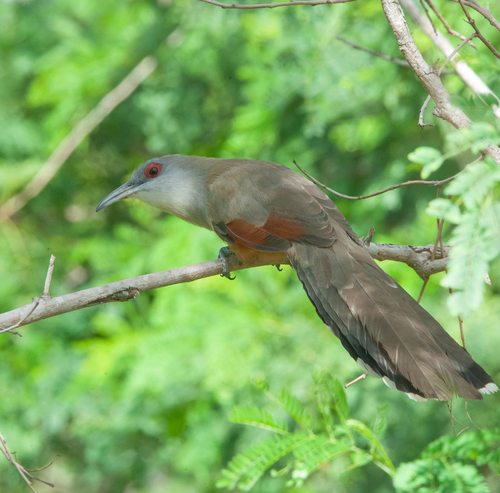
The great lizard cuckoo (currently also referenced by the scientific name Saurothera merlini Orbigny, 1839) is the largest species in the genus Coccyzus. It measures 42 to 54 cm (17 to 21 in) in total length, with the tail making up roughly half of this length, and weighs between 100 and 155 g (3.5 to 5.5 oz). Within each subspecies, both sexes share the same plumage, though males are larger than females. The species has a long, nearly straight bill, with a black or dusky upper mandible (maxilla) and a paler lower mandible. Adults of the nominate subspecies C. m. merlini have an olive-brown crown, nape, and upperparts. Their primary flight feathers are rufous, but this color is usually only visible when the bird is in flight. They have a whitish throat, pale gray cheeks and breast, and rufous belly and undertail coverts. The central pair of tail feathers are gray, while all other tail feathers are gray with wide white tips and a black bar just above the tip. A patch of bare red to orange skin surrounds the eye. Juveniles have narrower tail feathers than adults with faint white ends, and yellow skin around the eye. Subspecies C. m. santamariae is slightly smaller and paler than the nominate subspecies, and has a longer bill, but is otherwise very similar. Subspecies C. m. decolor has more grayish brown upperparts than the nominate and a shorter bill. Adults of C. m. bahamensis have several notable differences from the nominate subspecies: they are smaller, have grayer upperparts, a buff tint on the belly, and a black band near the end of all tail feathers. Juvenile C. m. bahamensis are similar to adult C. m. bahamensis, but have a slightly paler throat and breast and lack black bars on the tail. The subspecies of great lizard cuckoo have the following distributions: C. m. bahamensis is found on Andros, New Providence, Eleuthera, and Harbour islands in the Bahamas; C. m. santamariae is found on many small islands off the north-central coast of Cuba's main island; C. m. merlini is found on Cuba's main island, as well as Cayo Conuco and Cayo Saetía off Cuba's north coast; C. m. decolor is found on Isla de la Juventud (also called Isle of Pines). The three Cuban subspecies of great lizard cuckoo live in a wide range of landscape types, including mature semi-deciduous forest, evergreen forest, secondary forest, savanna, scrublands, and the undergrowth of pine forest. They occur at elevations ranging from sea level up to at least 1,250 m (4,100 ft). C. m. bahamensis is similarly non-selective in its habitat, living in semi-deciduous forest, deciduous forest, pine forest (especially forests with abundant vines), scrublands, and coffee plantations.