About Saurothera longirostris (Hermann, 1783)
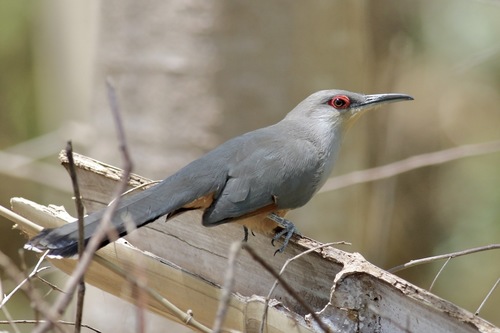
The Hispaniolan lizard cuckoo (scientific name Saurothera longirostris (Hermann, 1783)) is 41 to 46 cm (16 to 18 in) in total length, with approximately half of its length made up by the tail. Males weigh between 83 and 99 g (2.9 to 3.5 oz), while females weigh between 92 and 128 g (3.2 to 4.5 oz). Both recognized subspecies share a long straight bill, which has a black maxilla and a paler mandible. Within each subspecies, males and females have identical plumage. Adult nominate subspecies individuals have entirely gray upperparts. Their wings are chestnut with a rufous patch, their throat is rufous, their breast is pale gray, and their belly is rufous. They have a black tail, and the undersides of the tail feathers have large white tips. A patch of bare red skin surrounds their eye. Juvenile birds have brownish gray upperparts, a whitish throat, and a narrower brown tail with buff tips. The subspecies C. l. petersi is paler across its entire body than the nominate subspecies, and has a whitish throat. The nominate subspecies of the Hispaniolan lizard cuckoo occurs on Hispaniola (the main island in the Greater Antilles shared by Haiti and the Dominican Republic), as well as the offshore islands of Tortuga and Saona. C. l. petersi is found only on Gonâve Island, off the coast of western Haiti. This species lives in tropical deciduous forest, tropical evergreen forest, more open woodland, thickets, bush-covered mountain slopes, plantations, and gardens. It occurs across an elevation range from sea level up to 2,200 m (7,200 ft).