About Saucerottia saucerottei (Delattre & Bourcier, 1846)
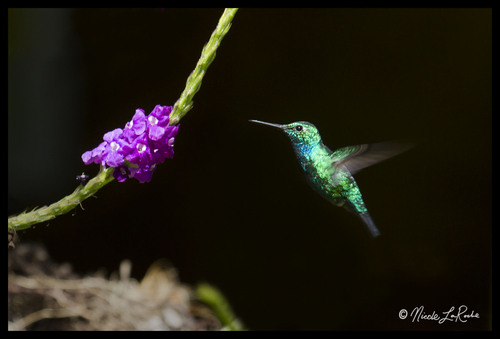
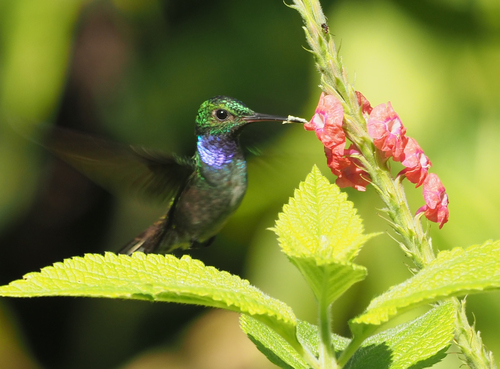
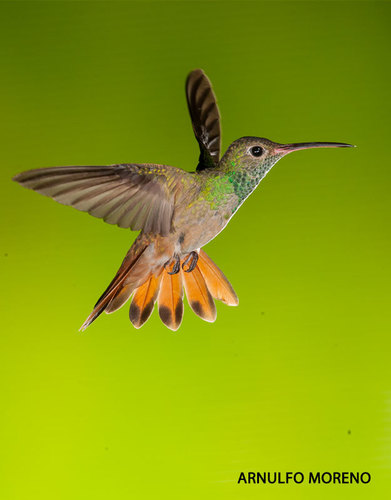
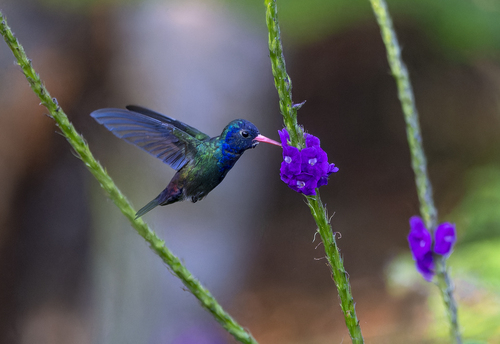
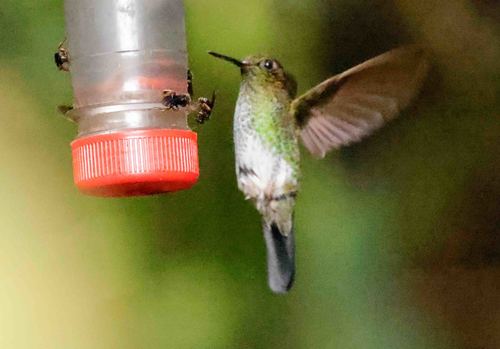
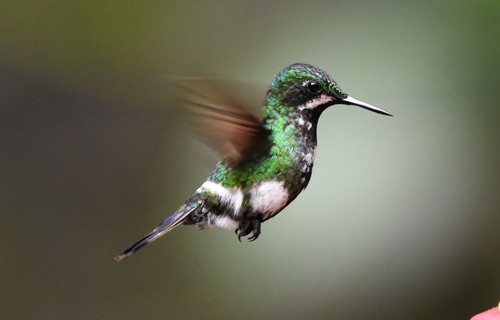
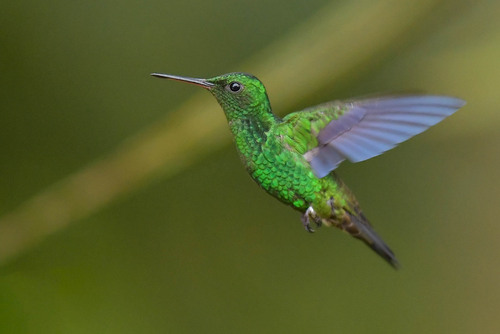
The steely-vented hummingbird, Saucerottia saucerottei, measures 8 to 11 cm (3.1 to 4.3 in) in length and weighs approximately 4.4 to 5.0 g (0.16 to 0.18 oz). For all subspecies, both males and females have a black bill, with a pinkish or reddish base on the lower mandible.
Adult males of the nominate subspecies have golden-green upperparts, blue-black uppertail coverts, and a blue-black tail. Their underparts are dark, glittering golden-green, with greenish to steel blue undertail coverts. Adult females have some white on their throat feathers and grayish-brown undertail coverts. Immature birds are generally similar to adult females but are overall duller; they also have a partly dark gray throat, a grayish brown belly, and brownish edges to their back and rump feathers.
Of the three recognized subspecies, the other two differ only slightly from the nominate. S. s. warscewiczi is somewhat smaller, and has a purplish to bluish tinge on its uppertail coverts. S. s. braccata has purplish tips on its rump feathers, and violet-blue to bluish uppertail coverts.
The subspecies S. s. warscewiczi is the northernmost population of steely-vented hummingbird. It occurs in northern Colombia, from Sucre Department east into western Zulia state in extreme northwestern Venezuela. The nominate subspecies, S. s. saucerottei, occurs in western and north-central Colombia, on the western slope of the Western Andes and in the Cauca River valley. S. s. braccata occurs in the Andes of western Venezuela, in the states of Trujillo and Mérida. Note that published range maps for this species include the range of the Central American blue-vented hummingbird.
The steely-vented hummingbird lives in semi-open to open landscapes, including scrublands, savanna, mature forest edges, secondary forest, plantations, and gardens. Most of these habitats are somewhat arid. Across most of the species' range, it occurs between sea level and 1,500 m (4,900 ft). The subspecies S. s. braccata typically occurs up to 2,000 m (6,600 ft), and rarely as high as 3,000 m (9,800 ft).