About Saucerottia edward (Delattre & Bourcier, 1846)
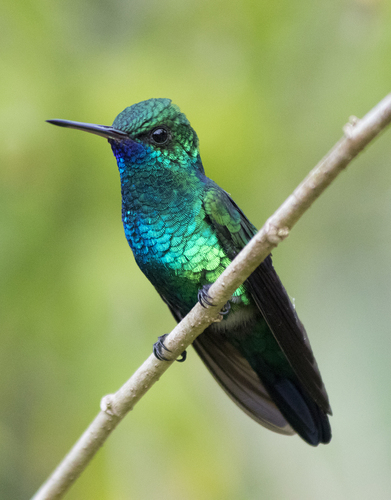
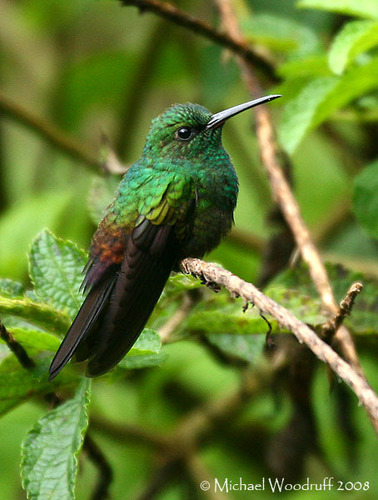
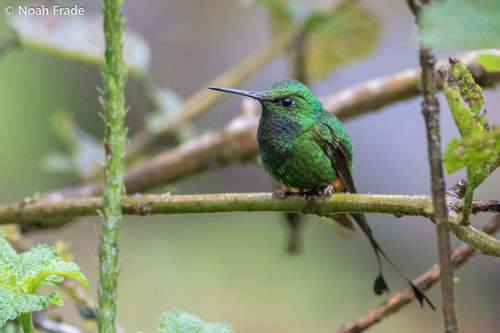
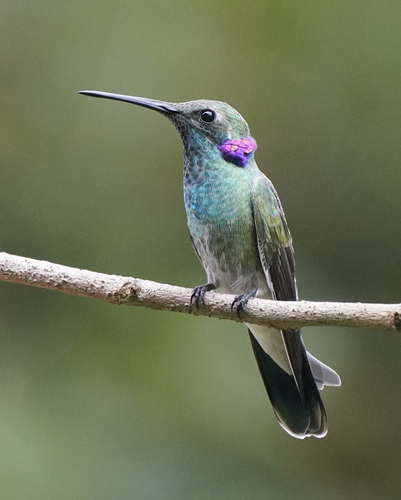
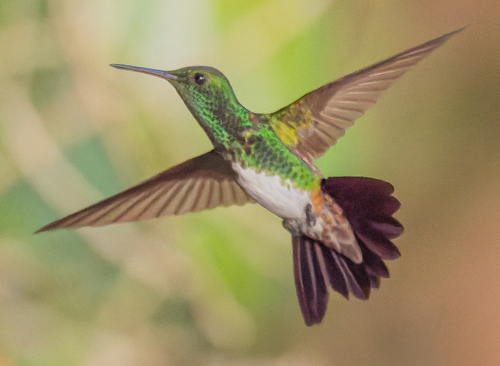
The snowy-bellied hummingbird, scientifically named Saucerottia edward, is 8 to 11 cm (3.1 to 4.3 in) long. Males weigh 5 to 5.4 g (0.18 to 0.19 oz), while females weigh 4.3 to 5.2 g (0.15 to 0.18 oz). For all subspecies and both sexes, the species has a straight blackish bill, with a reddish base on the mandible. Adult males of the nominate subspecies S. e. edward have bronze-green upperparts, with particularly coppery coloration on the back and rump. Their tails range from bronze to coppery, and sometimes have a purple sheen. Their throat and chest are glittering golden green, their belly has a V-shaped white center, and their undertail coverts are rufous. Adult females are similar in appearance to males, but have less intense green on their upperparts, a more whitish throat and undertail coverts, and light green tips on the outer tail feathers. Subspecies S. e. niveoventer is slightly larger than the nominate, and has a bluish black to purplish black tail. S. e. collata has less contrast between the green and copper of the back than the nominate, and has brownish undertail coverts. S. e. margaritarum has paler undertail coverts than the nominate, and a bronze to bronze-green tail. The four subspecies of the snowy-bellied hummingbird have separate distribution ranges. S. e. niveoventer is found from southwestern Costa Rica into western and central Panama, including Coiba Island. S. e. edward occurs in Panama from the Canal Zone east into Darién Province, with at least one recorded sighting in Chocó Department, northwestern Colombia. S. e. collata lives in central Panama. S. e. margaritarum is found in southwestern Darién, the Pearl Islands, and other islands in the Gulf of Panama, Panama. The species occupies different habitats across its range. In Costa Rica and western Panama, it favors semi-open areas including savanna, scrublands with scattered trees, edges and clearings of primary forest, secondary forest, coffee plantations, and gardens, and occurs at elevations from sea level up to 1,600 m (5,200 ft). S. e. collata inhabits fields with low herbs and bushes, at elevations between 500 and 850 m (1,600 and 2,800 ft). On islands, S. e. margaritarum lives in semi-open to open landscapes like abandoned fields, and also in mangroves; on the mainland, it is found in rainforest. This subspecies occurs at elevations between sea level and 700 m (2,300 ft).