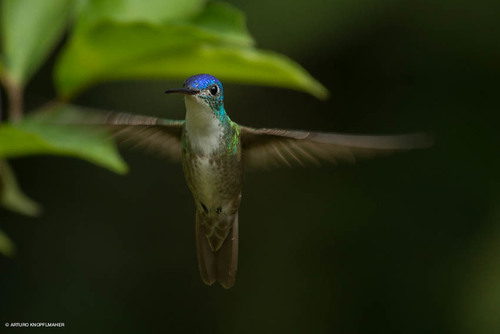
About Saucerottia cyanocephala (R.Lesson, 1830)
The azure-crowned hummingbird (Saucerottia cyanocephala) ranges from 10 to 11.5 cm (3.9 to 4.5 in) in length. Males have an average weight of about 5.8 g (0.20 oz), while females average about 5.4 g (0.19 oz). For both sexes of both recognized subspecies, the bill has a black maxilla and a dull pink mandible with a black outer third. Within each subspecies, the sexes are almost identical in appearance. Adult males of the nominate subspecies have a bright metallic blue crown; adult females of this subspecies have a duller blue to greenish blue crown. Both sexes of the nominate subspecies have metallic bronze nape and back. Their rump, uppertail coverts, and tail are greenish bronze to bronze green. Their face is mostly bluish green. Their underparts from the chin to the vent are white, with metallic bronze green on the sides of the breast and duller bronze green on the flanks. Immature azure-crowned hummingbirds are similar to adults but have duller plumage, grayish buff tips on the uppertail coverts, whitish tips on the outer tail feathers, and a buff wash across the underparts. Subspecies S. c. chlorostephana is somewhat smaller than the nominate subspecies. Its plumage is essentially identical to that of the nominate, except its crown is glittering green rather than metallic blue. The nominate subspecies is distributed from the Mexican state of Tamaulipas south through Belize, Guatemala, and El Salvador into north central Nicaragua. It inhabits humid evergreen forest edges, oak forest, pine-oak forest, scrublands, and secondary forest, and occurs at elevations between 600 and 2,400 m (2,000 and 7,900 ft). Subspecies S. c. chlorostephana has a disjunct range on the Mosquito Coast of eastern Honduras and northeastern Nicaragua, and primarily inhabits low-elevation pine savanna.