About Saucerottia beryllina (Deppe, 1830)
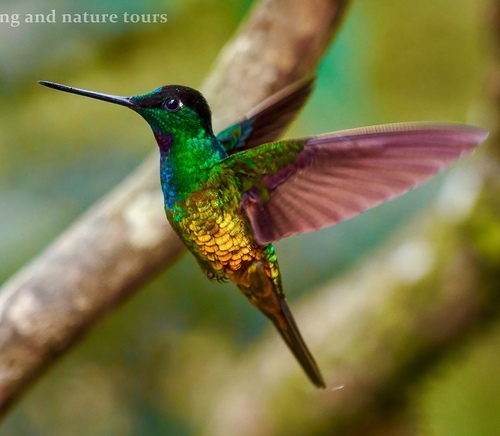
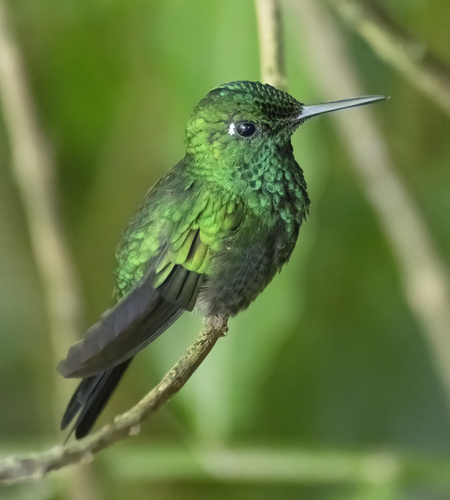
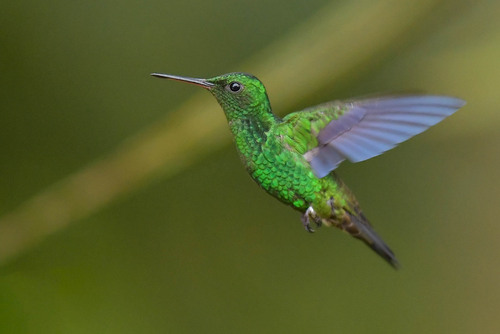
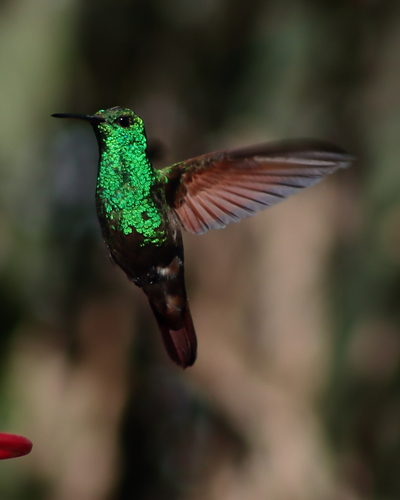
The berylline hummingbird, Saucerottia beryllina (Deppe, 1830), ranges 8 to 10 cm (3.1 to 3.9 in) in length. Males weigh approximately 4.4 g (0.16 oz) and females weigh approximately 4.0 g (0.14 oz). Across all subspecies, male bills have a black maxilla and a pinkish mandible with a black outer half. Adult males of the nominate subspecies S. b. beryllina have bronze-green to coppery head, back, and rump. Their uppertail coverts and tail are coppery to rufous. The bases of their primaries and secondaries are chestnut, which forms a visible patch when the wing is closed. Their underparts are glittering golden green. Adult nominate females are very similar to males, but have a paler, more grayish throat and belly, and entirely black bills. Juveniles resemble females but have a grayish cinnamon belly. The subspecies S. b. viola has a grayish tinge to its back and rump, a fawn to cinnamon belly, and dark violet uppertail coverts and tail. S. b. lichtensteini is overall lighter green than the nominate subspecies, and has a silvery tail. Male S. b. sumichrasti have duller green plumage than the nominate, with a purplish gloss on the tail; female S. b. sumichrasti have a silvery to purple cast on their central tail feathers. S. b. devillei has more bronze on the back and rump than the nominate, and a purplish to bronzy chestnut tail. The subspecies of berylline hummingbird are distributed across the following regions: S. b. viola is found in western Mexico from Sonora to Michoacán and Guerrero, and rarely occurs as far north as the southwestern United States. S. b. beryllina is found in central Mexico from México state south into Veracruz and Oaxaca. S. b. lichtensteini is found in western Chiapas, southern Mexico. S. b. sumichrasti is found in extreme southeastern Oaxaca, and northern and central Chiapas in southern Mexico. S. b. devillei occurs separately from the other subspecies, in a discontinuous range starting in southern Guatemala, extending through El Salvador into central Honduras. The berylline hummingbird primarily inhabits arid landscapes, including dense oak and pine-oak forest, scrublands, deciduous forest, thorn forest, gallery forest, plantations, and parks and gardens. It occurs at elevations from near sea level to the submontane zone, and is most commonly found between 500 and 1,800 m (1,600 and 5,900 ft).