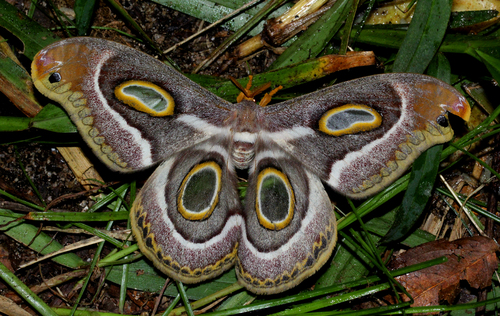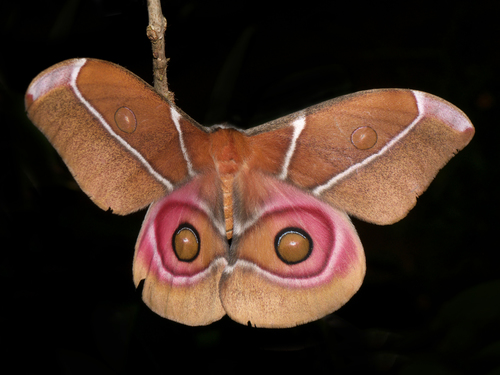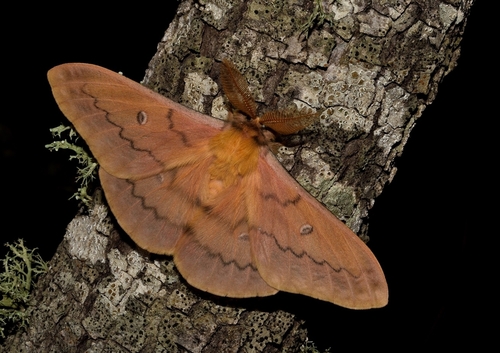
About Saturnia caecigena Kupido, 1825
Perisomena caecigena, commonly known as the autumn emperor moth, is a moth species belonging to the family Saturniidae. It was first formally described by Franz Josef Kupido in 1825, and its scientific name is also cited as Saturnia caecigena Kupido, 1825. This moth is distributed across an area starting from Italy, where it occurs east of Venice near the Croatian border, extending from southeastern Austria through Hungary, Slovenia, Croatia, Serbia, Albania, western Ukraine, Romania, Bulgaria, and Greece to most of Turkey and the Caucasus Mountains of Georgia, Armenia, and Azerbaijan. An isolated population lives in the mountains of Lebanon and Israel. The subspecies P. c. stroehlei is endemic to the Troodos Mountains of Cyprus. The wingspan of the nominate subspecies caecigena measures 62–88 mm. For subspecies stroehlei, males have a wingspan of 40–65 mm, while females have a wingspan of 48–90 mm. Adult autumn emperor moths are active from late September to early November. The larvae feed on Quercus oak species, which includes Quercus robur, Quercus petrea, Quercus pubescens, Quercus cerris and Quercus ilex. They also feed on Populus alba, Populus nigra, Fraxinus, Pyrus and Prunus. Salix is a possible host plant, as larvae have been successfully reared on Salix caprea in captivity.