About Sasia ochracea Hodgson, 1837
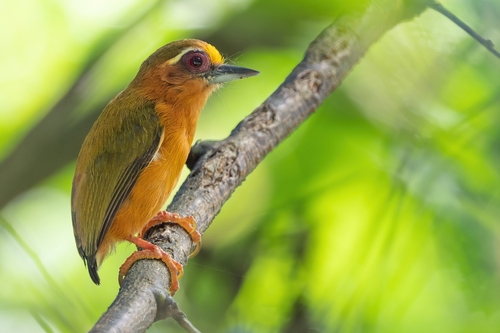
This small piculet species, Sasia ochracea, commonly called the white-browed piculet, grows up to 10 cm (4 in) in length. It has olive-green upperparts with a chestnut tinge, cinnamon or rufous underparts that are sometimes yellowish on the flanks, and a stubby, blackish tail. Its crown is green, with a white streak running above and directly behind the eye; the eye itself is surrounded by a ring of bare pinkish or reddish skin. Males have a small golden-yellow patch on the forehead that females do not have. Juveniles are duller-colored than adults, with greener upperparts and greyer underparts. The beak is grey, the iris is red, and the legs are yellow or orange; unlike most members of the woodpecker family which have four toes, this species only has three toes on its feet. Where their ranges overlap in southern Myanmar and southeastern Thailand, the white-browed piculet can be confused with the very similar rufous piculet (Sasia abnormis). It can be distinguished from the rufous piculet by the presence of the white streak above the eye and its darker beak. The white-browed piculet is native to tropical southeastern Asia. Its range extends from northern India, Nepal, Bhutan and Bangladesh through southern China to Myanmar, Laos, Vietnam and Thailand. It inhabits dense wet or dry forest with abundant vines and bamboo, as well as scrub and swampy woodlands. It occurs at altitudes up to 2,600 m (8,500 ft). The white-browed piculet forages in the understory, not far above the ground, pecking and probing with its sharp beak. Its diet is made up of small insects including bark beetles, ants, and termites, plus spiders and other small invertebrates. It often forages in pairs, and may also join small mixed-species flocks. It sometimes descends to the ground, where it can hop for short distances. This bird builds its nest using pieces of bamboo. It picks up fragments of broken bamboo with its feet, and uses its beak to pull away partially broken fragments. Breeding occurs between March and July.