About Sasia abnormis (Temminck, 1825)
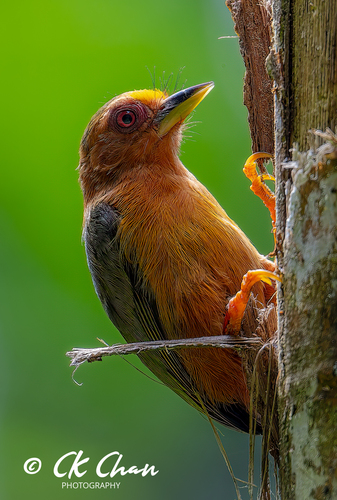
The rufous piculet, with the scientific name Sasia abnormis (Temminck, 1825), is a very small bird. It has short wings and an almost non-existent tail, with a total length ranging from 8 to 10 cm (3 to 4 in). Its upper parts are generally green with a bronze tint, while its underparts are rufous, orange, or cinnamon, with paler flanks. The mantle and back are olive, the upper surface of the wings is brownish, and the underwings are buff. Its short stumpy tail is blackish on the upper side, edged with olive. Males and females of this species have distinct physical differences: the male has a yellow or golden patch on the forehead, while the female has a bronze patch on the forehead, and the female also has a larger beak than the male. For both sexes, the upper mandible is blackish and the lower mandible is yellowish. The iris is reddish, and there is a ring of bare pinkish or purplish skin surrounding the eye. The legs and feet are yellowish or orange, and this species has just three toes on each foot, whereas four toes is the normal arrangement for the woodpecker family. Juvenile rufous piculets are rather more grey in overall coloration. This bird is native to tropical southeastern Asia. Its range extends from southern Myanmar, through Thailand and the Malay Peninsula, to the Greater Sunda Islands and Borneo. It is a resident, sedentary species. It is generally restricted to lowlands and hills, reaching altitudes of up to about 1,600 m (5,200 ft) in Borneo. Its typical habitat is dense humid secondary forests with tangled undergrowth, vines, creepers, bamboos, and dead rotting trees, and it is often found near streams. The rufous piculet is an active bird that moves singly or in small groups through the lowest forest storeys, usually staying within 5 m (16 ft) of the ground. It forages on trunks, dead branches, vines, in bushes, among bamboos, and in tall grasses. It gleans prey scrupulously, probing into holes and pulling out insects with its long tongue. It sometimes works its way up a trunk crosswise, making short flights to turn and face the opposite direction. When foraging in a group, multiple members often work in synchrony. Its diet consists of ants, ant larvae, termites, small beetles, spiders, and other small invertebrates. The breeding season occurs in February in Borneo; in Malaysia, nestlings have been recorded in May and June. Nests are sometimes located in holes in dead branches, and other times in bamboo.