About Sarracenia purpurea L.
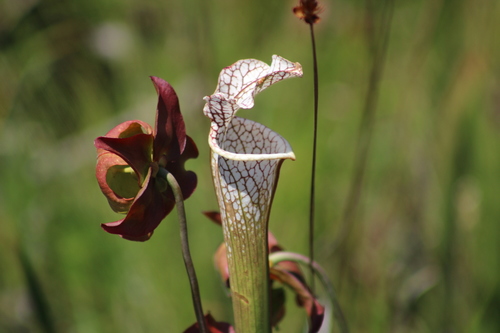
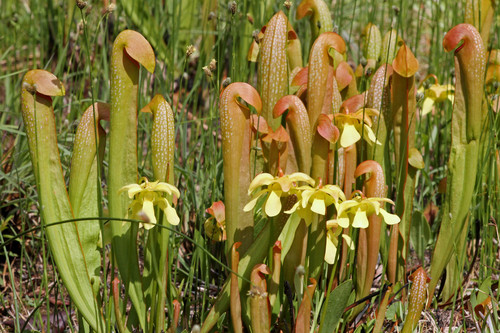
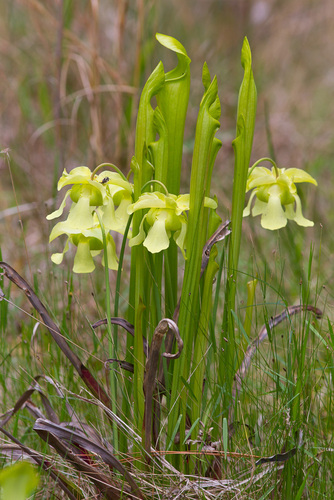
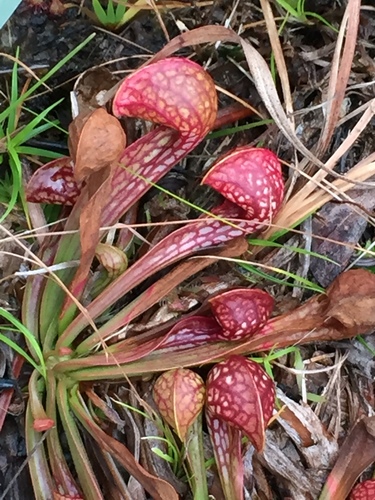
Sarracenia purpurea, commonly called the purple pitcher plant, northern pitcher plant, turtle socks, or side-saddle flower, is a carnivorous plant belonging to the family Sarraceniaceae. All species in the Sarracenia genus grow in nutrient-poor, acidic bogs. The natural range of S. purpurea covers the Eastern seaboard of North America, the Great Lakes region, almost all of Canada (excluding only Nunavut and Yukon), Washington state, and Alaska. This range makes S. purpurea the most common and most widely distributed pitcher plant, and it is also the only member of the Sarracenia genus that grows in cold temperate climates. How this species achieved such a broad distribution remains unexplained. Current data shows that Sarracenia has a median seed dispersal distance of just 5 cm (2 inches), which is too short to account for the species' widespread range across North America. Across most of the southern portion of its natural range, S. purpurea is classified as endangered or vulnerable. Most varieties that were once classified as Sarracenia purpurea along the United States Gulf Coast have since been reclassified as the separate species Sarracenia rosea. S. purpurea is an introduced, naturalized species in Europe and the northwestern United States. It occurs in habitats occupied by the native carnivorous plant Darlingtonia californica, in the Klamath Mountains and northern Sierra Nevada. Established populations of the species have also been recorded in Washington state, Austria, the Czech Republic, Denmark, France, Germany, Ireland, Sweden, Switzerland, and the United Kingdom. In Britain and Ireland, the purple pitcher plant was introduced to some heather-rich peatbogs, and has become integrated into the local flora of these specific areas thanks to the mild local climate. However, observations collected by researchers over nearly a century have found no evidence that the plant spreads to other bogs in this region, due to the highly fragmented distribution of bogs in Britain and Ireland. S. purpurea was used as a medicinal plant by Native American and First Nation tribes within its northeastern and Great Lakes ranges, including the Algonquin, Cree, Iroquois, and Mi'kmaq (Micmac) peoples. It was primarily used to treat smallpox, prepared as a root infusion. A 2012 study found that Sarracenia purpurea is effective as a treatment for viruses in the Orthopoxvirus family (including the smallpox virus), working by inhibiting early virus transcription.