About Sarracenia leucophylla Raf.
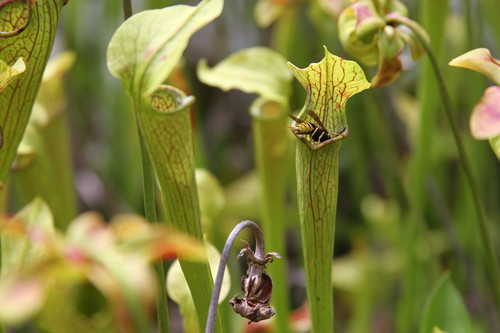
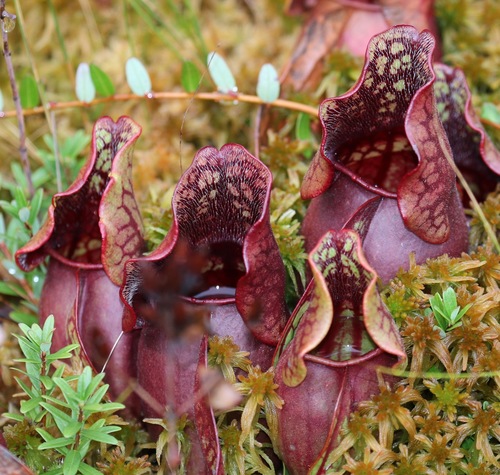
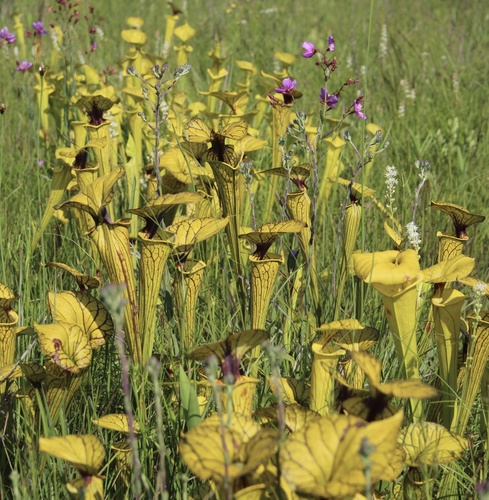
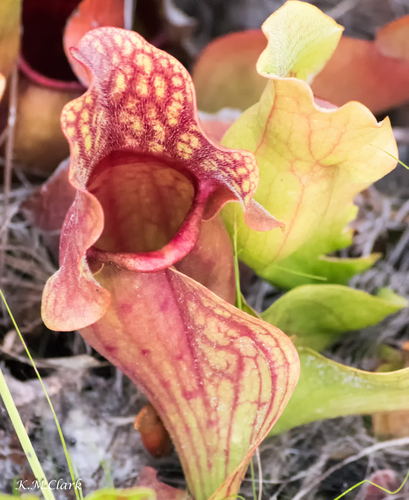
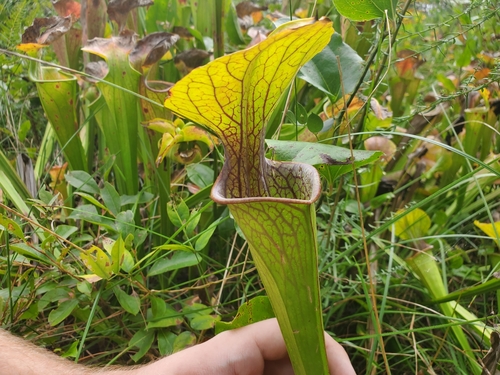
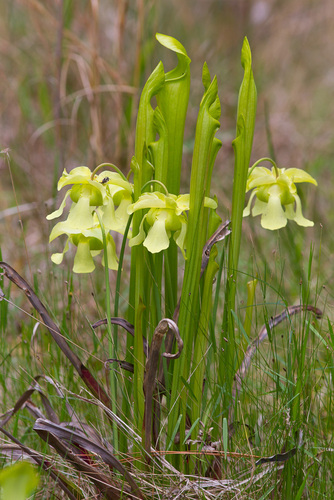
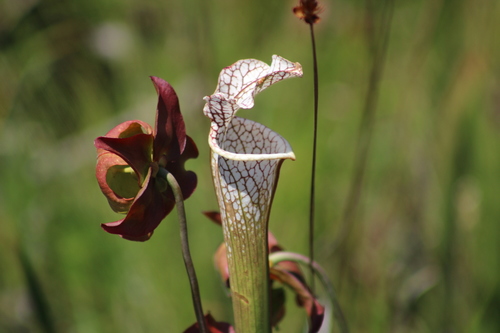
Sarracenia leucophylla Raf., the white-topped pitcher plant, produces nodding brownish-red flowers and clusters of erect, hollow, pitcher-shaped leaves. Each leaf has a white background patterned with reddish-purple veins at its upper portion, and is capped by an erect, roundish hood with wavy edges. This species varies widely in height: plants from some locations can grow almost 1 metre (3.3 ft) tall, while others are very small. A rarely encountered 30-centimetre (12 in) tall dwarf form is endemic to Garcon Point in Santa Rosa County, Florida. Like all Sarracenia species, Sarracenia leucophylla is native to North America, and is specifically endemic to the Southeastern United States. It grows in moist, low-nutrient longleaf pine (Pinus palustris) savannas, found mainly along the U.S. Gulf Coast, generally west of the Apalachicola River on the Florida Panhandle. It also occurs naturally in Alabama, Georgia, Louisiana, Mississippi, and North Carolina; in North Carolina, it has been introduced by humans to areas outside its native range. Sarracenia leucophylla is cultivated as an ornamental plant. Despite originating from the Southeastern U.S., it is unusually cold hardy, and can be grown outdoors even in USDA zone 6 and colder climates with proper winter protection. In cultivation, it is generally less tolerant of stagnant water, and requires well-draining soil that still holds enough moisture to prevent root rot. Several distinct cultivated clones of this species are recognized: 'Schnell's Ghost', a yellow-flowered clone with very little red pigment in its pitchers (it is not completely free of anthocyanin); 'Hurricane Creek White', a group of mostly white plants originally collected from Hurricane Creek, Alabama; 'Tarnok', a mutant that produces showy, sterile double flowers; and 'Titan', an especially tall, robust form that can produce fall pitchers over 38 inches (97 cm) tall.