About Sarracenia flava L.
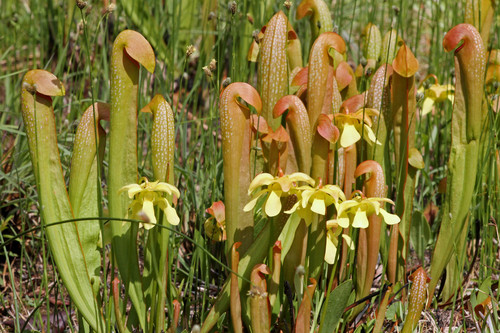
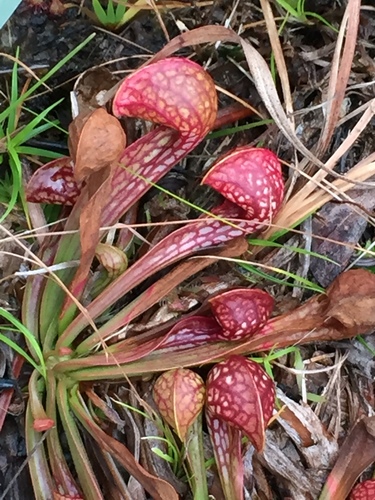
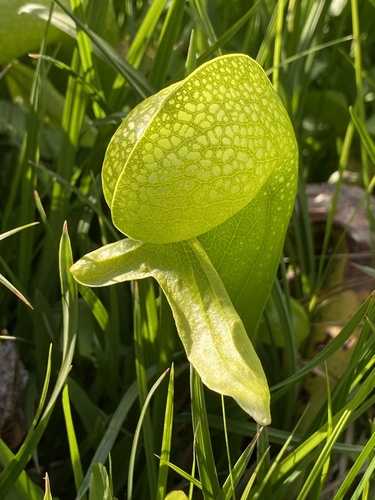
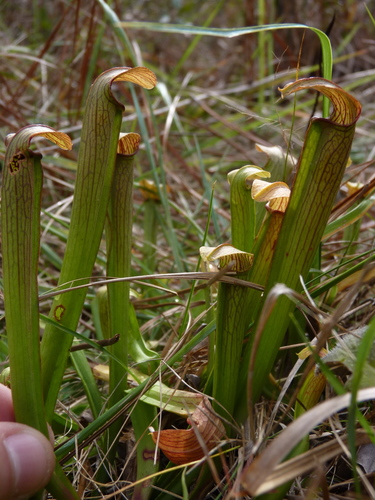
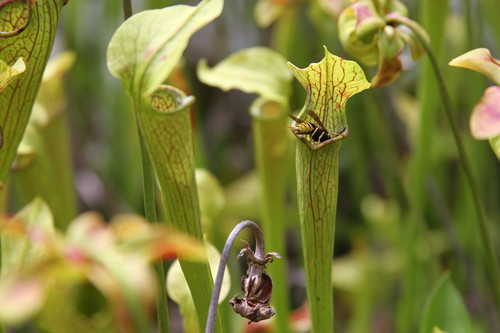
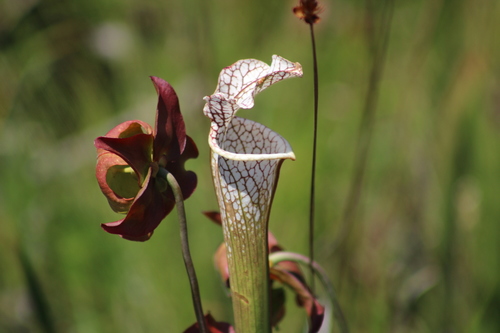
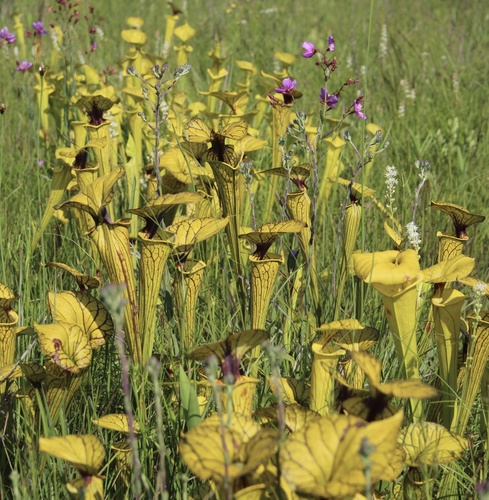
Sarracenia flava L., commonly called the yellow pitcherplant, is a carnivorous plant species in the family Sarraceniaceae. Like all members of Sarraceniaceae, it is native to the New World. Its natural range extends from southern Alabama, through Florida and Georgia, to the coastal plains of southern Virginia, North Carolina, and South Carolina. Additional populations can also be found in the Piedmont, the mountains of North Carolina, and Mendocino County, California. Like other species in the genus Sarracenia, the yellow pitcherplant traps insects using a modified rolled leaf. This leaf is vibrant yellow in color, and can grow to over one meter (3 feet) in height, though a height of 50 centimeters (20 inches) is more typical. The top of the leaf flares out into a lid called the operculum, which stops excess rain from entering the pitcher and diluting the digestive secretions inside it. The upper sections of the pitcher are covered in short, stiff, downward-pointing hairs that guide insects that land on the upper leaf toward the opening of the pitcher tube. These upper regions also have bright flower-like anthocyanin markings, especially in the varieties S. flava var. rugelii and S. flava var. ornata; these markings also work to attract insect prey. The opening of the pitcher tube is bent backward into a 'nectar roll' called the peristome, whose surface is dotted with nectar-secreting glands. The nectar contains not just sugars, but also the alkaloid coniine, a toxin also found in hemlock, which likely intoxicates visiting prey. Once prey enters the tube, the smooth, waxy secretions coating the surfaces of the upper tube make footing extremely uncertain for insects. Insects that lose their footing on this surface fall to the bottom of the tube, where a combination of digestive fluid, wetting agents, and inward-pointing hairs stop them from escaping. Some large insects such as wasps have been reported to occasionally escape from pitchers by chewing their way out through the tube wall. In spring, the plant produces large flowers with 5-fold symmetry. The yellow petals are long and strap-shaped, and dangle over the flower's umbrella-style style, which is held upside down at the end of a 50 cm (20 inch) long scape. The flower's stigma are located at the tips of the 'spokes' of this umbrella-shaped structure. Pollinating insects typically enter the flower from above, forcing their way into the cavity between the petals and the umbrella-shaped style, and deposit any pollen they carry on the stigma as they enter. Pollinators usually exit the flower after getting coated in the plant's own pollen by lifting a petal. This one-way movement system helps ensure cross pollination occurs. In late summer and autumn, the plant stops producing carnivorous leaves and instead produces flat, non-carnivorous leaves called phyllodia. This trait is likely an adaptation to lower light levels and lower insect availability during the winter months, and it clearly demonstrates the energy cost of producing carnivorous leaf structures. The yellow pitcherplant is easy to cultivate, and is one of the most popular carnivorous plants grown in horticulture. It also hybridizes easily with other members of the genus Sarracenia. The hybrids S. x catesbaei (from a cross between S. flava and S. purpurea) and S. moorei (from a cross between S. flava and S. leucophylla) occur naturally in the wild, and are also popular with carnivorous plant collectors.