About Sarpa salpa (Linnaeus, 1758)
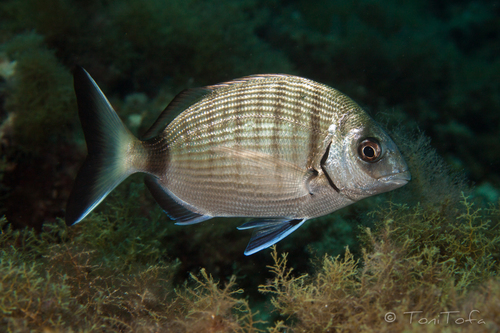
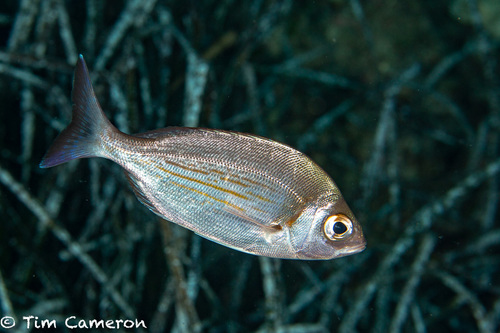
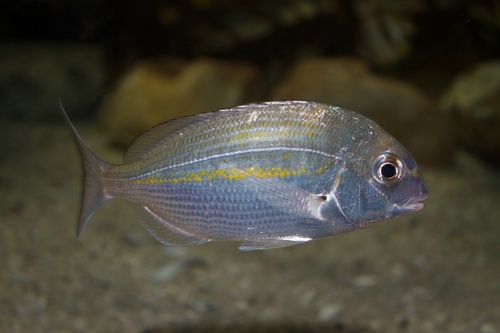
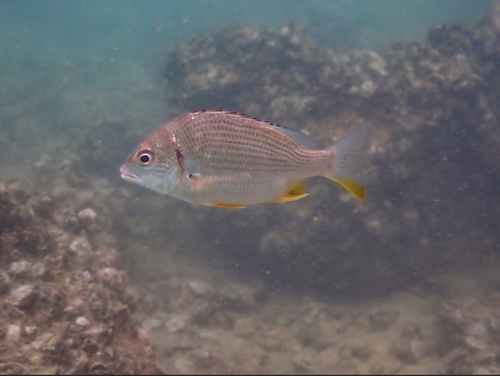
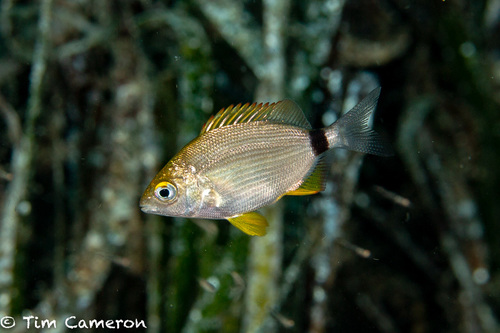
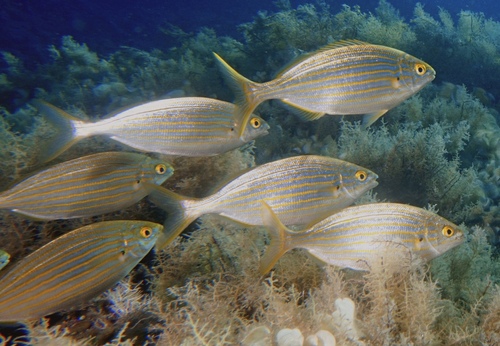
The salema porgy (also called saupe), Sarpa salpa, has a moderately slender, smoothly oval body, with its body depth measuring 2.8 times its standard length. Its dorsal fin is supported by 11 spines and 14 or 15 soft rays, while the anal fin has 3 spines and 13 to 15 soft rays. Scales are present on the cheeks below the eyes, and there is a scaly sheath at the base of the anal fin. However, the area between the eyes, the base of the anal fin, and the flange of the preoperculum are all scaleless. The upper jaw holds a single row of notched incisor-like teeth, and the lower jaw holds pointed incisor-like teeth; there are no molar-like teeth. The body is silvery, with 8 to 10 horizontal golden stripes running along the sides, and a black spot at the base of the pectoral fin. Males typically grow to 15 to 30 cm (6–12 in) in length, while females usually reach 31 to 45 cm (12–18 in). The maximum recorded total length of the species is 51 cm (20 in).
Salema porgy are found in the eastern Atlantic Ocean, ranging from the Bay of Biscay south to South Africa, and also live throughout the Mediterranean Sea. Individuals have occasionally been recorded as far north as Great Britain. The species is generally common, and occurs from near the surface down to a depth of 70 m (230 ft).
The saupe's vegetarian diet, modest size, and habitat make it not very vulnerable to net or harpoon fishing. For this reason, it is rarely served as food and is practically not sold commercially. It is rarely consumed today except in France, Israel, and Tunisia. Sarpa salpa became widely known for its ichthyoallyeinotoxic effects after widely publicized reports from 2006, when two men ate the fish at a Mediterranean restaurant and experienced many auditory and visual hallucinations. These frightening hallucinations started two hours after ingestion and lasted a total of 36 hours. A study of Mediterranean specimens found that the fish, especially its viscera, is potentially unsafe to eat. Saupes are not toxic year-round, only becoming toxic during certain periods. This has led to suspicion that toxins from algae or phytoplankton, which bloom at specific times and are eaten by the fish, cause the fish to become ichthyoallyeinotoxic. Since the accidental introduction of the alga Caulerpa taxifolia to the Mediterranean, saupes have accumulated toxins produced by this alga in their bodies. It is therefore recommended that saupes be gutted as soon as they are caught.