About Sarotherodon melanotheron Rüppell, 1852
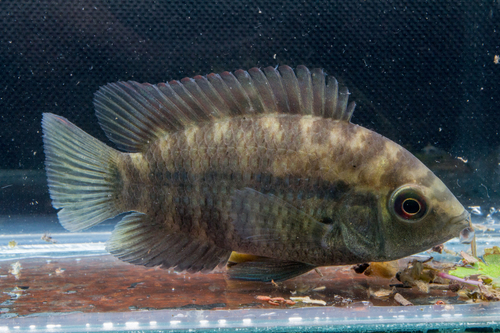
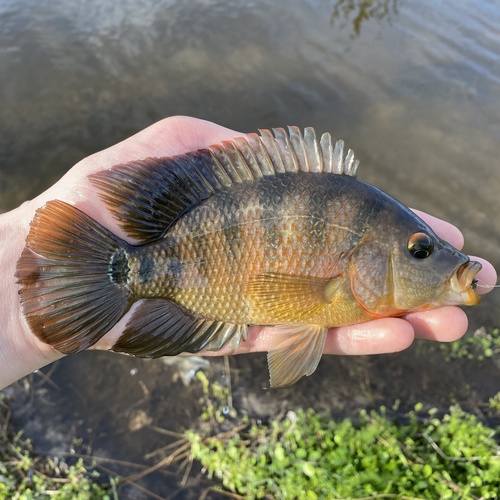
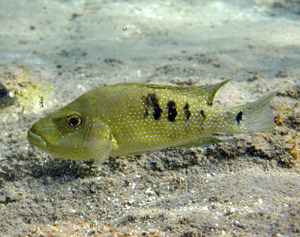
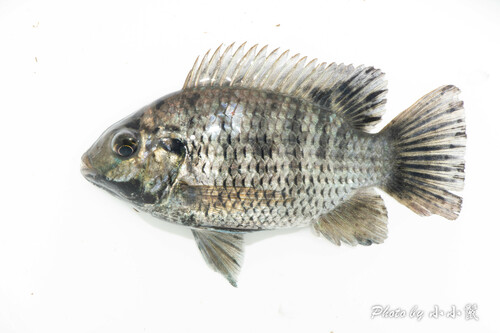
Sarotherodon melanotheron, commonly called the blackchin tilapia, is generally pale in color, with shade variations including light blue, orange, and golden yellow. Adult individuals normally have dark patches on the chin. It also typically shows dark coloration on the posterior edge of the gill, and on the tips of the soft rays of the dorsal fin. The body is usually marked with irregular bars, spots, or splotches. It has a small mouth that holds up to several hundred tiny teeth arranged in 3–6 rows. This species shows minimal sexual dimorphism: the heads of adult males are usually slightly larger than females’ heads, and some males may also show a gold tint on the operculum. The dorsal fin has 15–17 spines and 10–12 soft rays, the anal fin has 3 spines and 8–10 soft rays, and the length of the caudal peduncle is 0.6–0.9 times its depth. Blackchin tilapia can reach a maximum total length of 28 centimetres (11 in), but most individuals grow to 17.5 centimetres (6.9 in). The blackchin tilapia is native to western Africa, ranging from Mauritania to Cameroon. It has been introduced to multiple countries in Asia, the USA, and Europe, and has become an invasive species in Florida, Thailand, and the Philippines. This tilapia can tolerate high salinities. It is abundant in mangrove areas, and can move into freshwaters such as the lower reaches of streams, as well as into fully salt water. In its native West Africa, it is restricted to brackish lagoons and estuaries, and is abundant in mangroves. It forms schools and is largely nocturnal, though it will feed during the day on rare occasions. Its diet is mostly made up of aufwuchs and detritus, supplemented with bivalves and zooplankton. It feeds by picking up food and swallowing it in bites, and lacks gill rakers. Spawning takes place close to shore in shallow water. The female actively courts the male, digs mating pits, and leads the mating process. The male ultimately responds in a mostly passive manner, after which the pair forms a bond. This species is a paternal mouth brooder, but females of one strain found in Ghana also have the ability to perform oral brooding. The blackchin tilapia is harvested for human consumption, and is also bred and collected for the aquarium trade.