About Saron marmoratus (Olivier, 1811)
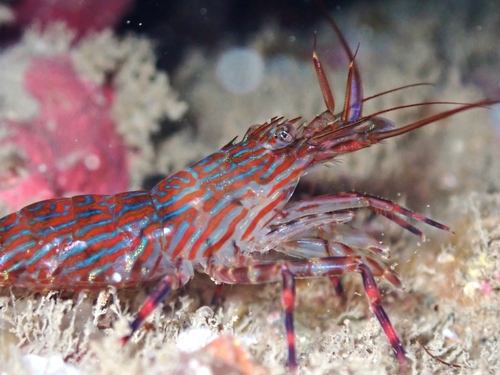
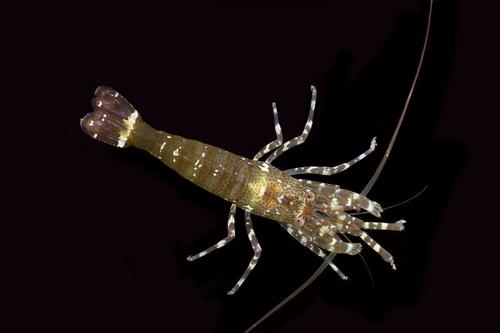
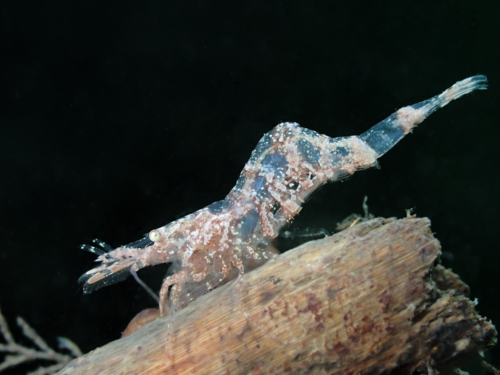
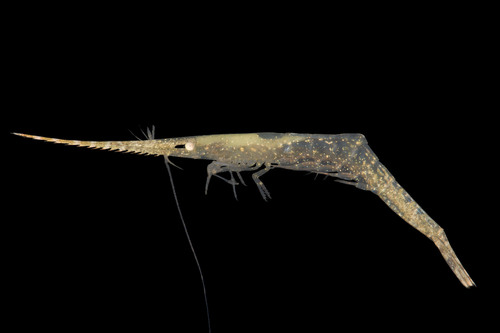
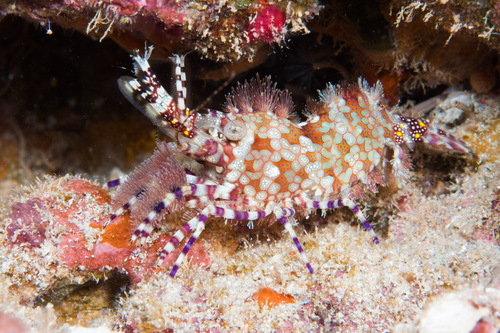
Saron marmoratus is a hunch-backed species of shrimp. Its rostrum is slightly longer than its carapace and strongly recurved. It has 1 or 2 spines on the rostrum's dorsal margin, followed by 3 or 4 spines on the carapace, and there are 8 to 10 long spines on the ventral margin of the rostrum. The dorsal margin of the carapace and the abdomen have tufts of setae, which are denser in females. Males have elongated chelae that are longer than their body, while females have a distinct brush-like setal structure on their first pair of legs. The legs bear brown or blue transverse bands. This species is variable in colour: its base ground colour can be red, blue or brown, and is mottled with brown or green. The legs are marked with blue or brown transverse bands. Saron marmoratus has an Indo-Pacific distribution. Its range extends from the Red Sea south to Madagascar and Mozambique, and east through the Persian Gulf, India, and Southeast Asia, across the southern Pacific to include Australia and as far east as Hawaii. In 2013, specimens were observed near underwater caves off the coast of Lebanon, and it is thought that this species has completed a Lessepsian migration through the Suez Canal, moving from the Red Sea into the Levantine Sea. Saron marmoratus is in high demand for the aquarium hobby and commands good prices in the marine aquarium trade. Specimens sold on the European market are usually collected from the Red Sea, while specimens for sale in North America are collected in Hawaii.