About Sarmarutilus rubilio (Bonaparte, 1837)
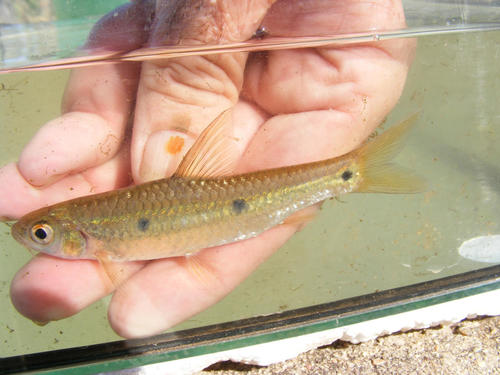
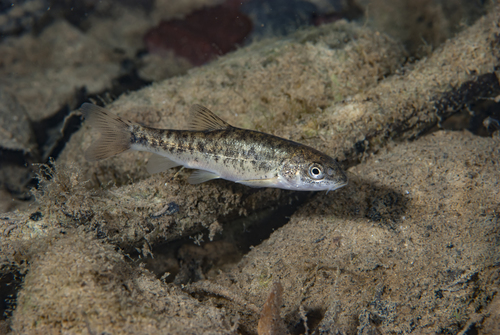
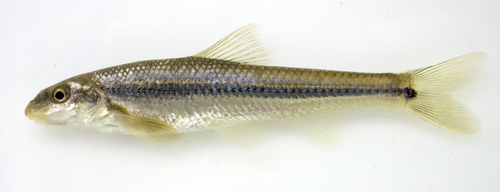
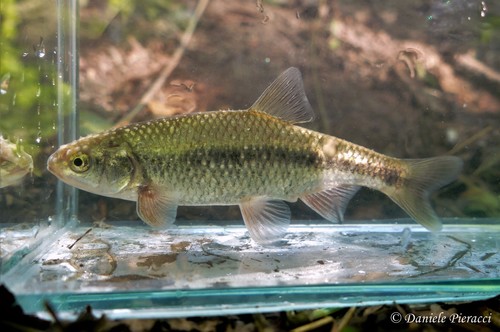
Sarmarutilus differs from the closely related genera Rutilus and Leucos by three key characteristics. First, it has 5 pharyngeal teeth on each side. Second, breeding males develop nuptial tubercles at the center of every scale on their head and body. Third, the lateral stripe of the species is obscured by a crescent-shaped region of dense pigmentation, which is formed by distinct triangular spots on the crescent of each scale. This species reaches a maximum standard length of 18 centimeters (7.1 inches). The genus Sarmarutilus is endemic to Italy. Within its native range, it occurs from the Magra River south to the Sele River in the drainage basins of the Ligurian Sea and Tyrrhenian Sea, and from the Tronto River to the Trigno River in the Adriatic drainage basin. The exact size of its native range is not clear, because this fish has been widely introduced into rivers south of its documented native range, reaching as far south as Sicily. The species, commonly called rovella, is a habitat generalist, but it is typically absent from deeper, slower-flowing river reaches. It prefers upper river reaches with clear water, rocky to stony substrates, and aquatic vegetation. In some regions, it can also be found in drainage channels, lakes, and reservoirs.