About Sarkidiornis melanotos (Pennant, 1769)
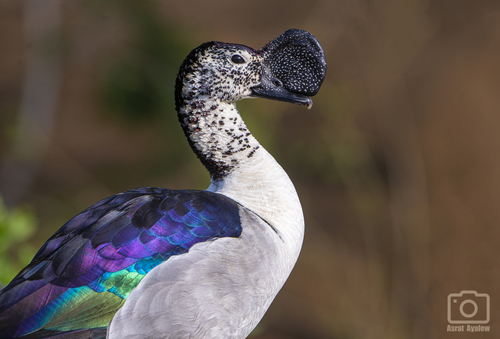
This species, commonly known as the knob-billed duck (scientific name Sarkidiornis melanotos (Pennant, 1769)), is common, unmistakable, and ranks among the largest duck species. It ranges in length from 56 to 76 cm (22 to 30 in), has a wingspan of 116 to 145 cm (46 to 57 in), and weighs between 1.03 and 2.9 kg (2.3 to 6.4 lb). Adult knob-billed ducks have a white head freckled with dark spots, a pure white neck, and pure white underparts. Their upperparts are glossy blue-black, with bluish and greenish iridescence that is especially prominent on the secondaries, the lower arm feathers. Males are much larger than females, and have a large black knob on the bill. Juvenile birds have dull buff coloration on the underparts, face, and neck, with dull brown upperparts, crown, and an eyestripe. Compared to comb ducks, knob-billed ducks are generally larger, and their flanks are usually lighter, appearing light grey and sometimes whitish in females. Immature knob-billed ducks resemble large greyish female cotton pygmy geese (Nettapus coromandelicus), and can be hard to distinguish when no other birds are present for size and color comparison. However, immature knob-billed ducks are rarely found without nearby adults, so they are usually easy to identify. The knob-billed duck is silent except for producing a low croak when flushed. In terms of ecology, this duck breeds in still freshwater swamps and lakes in the tropics. It is largely resident, only dispersing during the wet season. It feeds mostly on vegetation via grazing or dabbling, and less commonly eats small fish, invertebrates, and seeds. It can become a nuisance for rice farmers. Knob-billed ducks often perch in trees, and are typically found in flocks. Flocks are small during the wet season, and can reach up to 100 individuals in the dry season. Sometimes flocks separate by sex. While local populations of the knob-billed duck are declining, its wide range means it is not considered globally threatened by the IUCN. It is one of the species covered by the Agreement on the Conservation of African-Eurasian Migratory Waterbirds. For reproduction, African knob-billed duck populations breed during and after the rainy season, and may skip breeding if rainfall is low. Knob-billed ducks nest mainly in tree holes, and will also nest in tall grass. Males may have two mates at the same time, or up to five successive mates. They defend females and young, but do not defend nest sites. Females lay 7 to 15 yellowish-white eggs.