About Saribus rotundifolius (Lam.) Blume
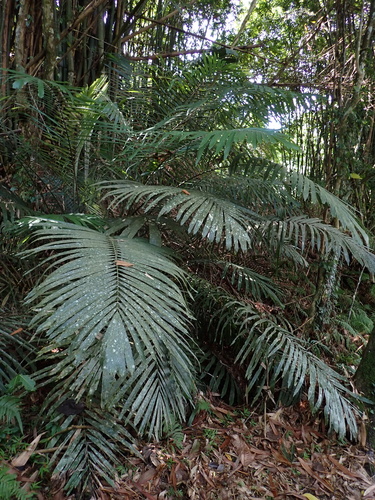
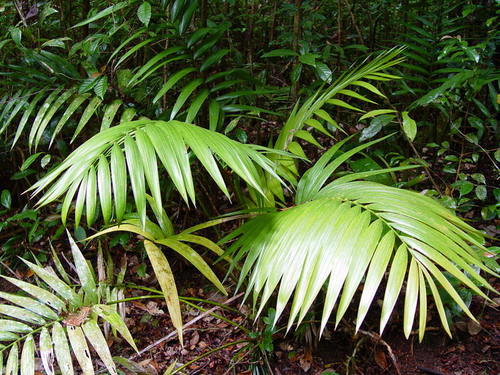
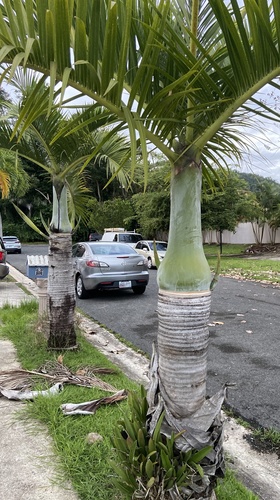
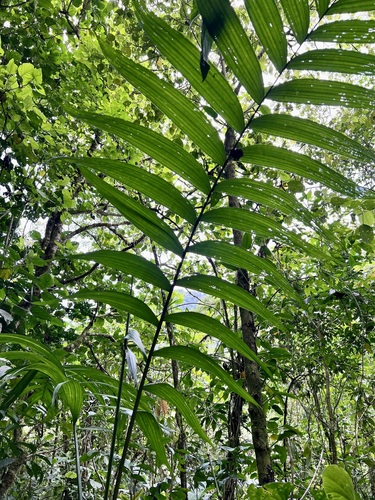
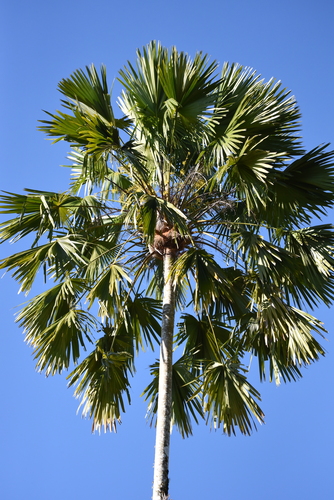
Saribus rotundifolius is a hermaphrodite evergreen fan palm that grows with a single solitary erect trunk. It typically reaches 15 to 25 metres in height, and exceptionally can grow as tall as 45 metres. At breast height, its trunk has a diameter of 15 to 25 centimetres. This equals a typical height of around 18 metres (60 feet), and it may rarely reach 27 metres (90 feet) tall. Its trunk is smooth, straight, massive, and tapering, marked with shallow rings of old leaf scars. Young individuals have a green crown. This species very rarely retains a slight skirt of drooping dead leaves on its trunk. Its leaf sheaths are chestnut brown. Its palmately-lobed leaves grow in a spiral arrangement around the trunk, with long petioles. The full leaf measures around 1.2 metres long, and the leaf blade is entire at its centre, with an almost round outline. The blade is regularly divided to roughly half its length, with a diameter of 1.2 metres. The leaf segments are shallowly forked at their ends, and each has a single main nerve. Flowers grow on an inflorescence with a long 0.9 to 1.2 metre peduncle. The three-petalled flowers grow in bunches. The fruit is a fleshy drupe, around 2 centimetres in diameter and roughly round. Unripe ripe fruit is brick red, and turns fully black when fully ripe. This palm is native to Indonesia's Sulawesi and Maluku Islands, and the Philippines. Its native range extends west to Banggi Island in Sabah, Malaysia, off the northeastern tip of Borneo, and east to the Raja Ampat Islands near Maluku, off the northwestern tip of the Bird's Head Peninsula in Indonesia's West Papua province. Its northernmost native occurrence is in the Philippines, where it is abundant across the country. It has been introduced to the wild in Java, the Lesser Sunda Islands, Peninsular Malaysia, Trinidad and Tobago, and India. On Java, it grows in western and central-eastern parts of the island. It is usually a cultivated plant there, but had already escaped into the wild and become locally abundant in some areas by the 1960s. The caterpillars of two lepidopteran species, Suastus gremius and Elymnias hypermnestra, use Saribus rotundifolius as a host plant. This tree only flowers once it is very old, and its flowers are pollinated by bees. Saribus rotundifolius can be grown in humid tropical regions. It is a common landscaping palm in the Philippines, and has been widely cultivated for a long time in Peninsular Malaysia, Singapore, Java, and other areas. It is cultivated as an ornamental plant across Colombia. Its ripe fruit is quite attractive. Its leaves are used for thatching roofs and wrapping food. Overharvesting of leaves causes the leaves that regrow after harvest to be smaller; while regrowth is faster after harvest, new leaves do not reach their previous full size. The foliage of Saribus rotundifolius is the unofficial national leaf of the Philippines.