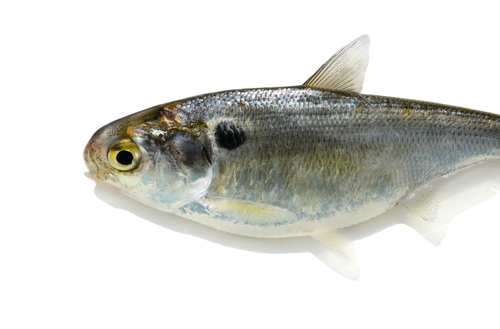
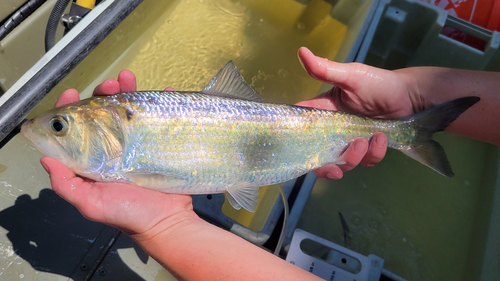
About Sardina pilchardus (Walbaum, 1792)
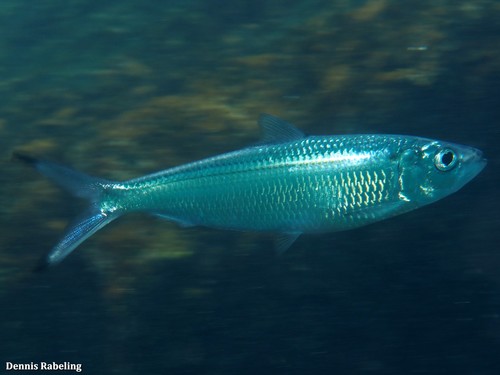
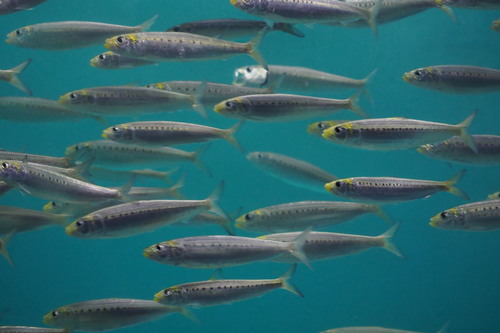
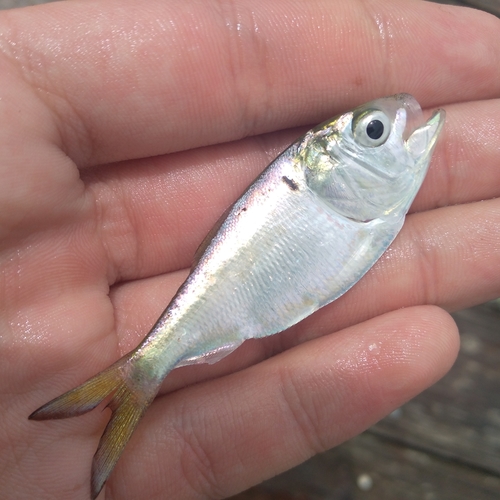
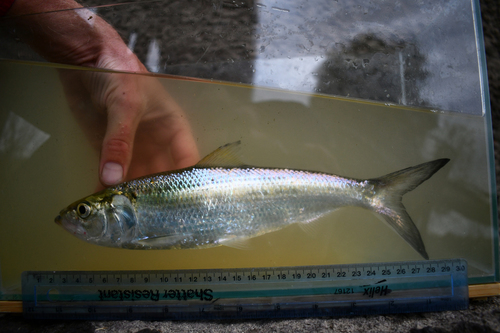
The European pilchard, scientific name Sardina pilchardus (Walbaum, 1792), is a small to medium-sized, somewhat elongated, herring-like fish. The origin of its pelvic fins sits well behind that of the dorsal fin, and the last two soft rays on its anal fin are larger than the rest of the rays. Its upper body is green or olive, its flanks are golden, and its belly is silvery. It can be distinguished from the California pilchard Sardinops sagax, its American counterpart, by several traits: the European pilchard does not have a row of dark blotches, it has irregularly arranged scales, its ventral scutes have sturdier, more prominent keels, and its gillrakers are significantly different from those of Sardinops sagax. European pilchard occurs in the northeastern Atlantic Ocean, the Mediterranean Sea, and the Black Sea. Its range extends from Iceland and the southern parts of Norway and Sweden southwards to Senegal in West Africa. In the Mediterranean Sea it is common in the western half and the Adriatic Sea, but uncommon in the eastern half and the Black Sea. It is a migratory, schooling, largely coastal species, but sometimes travels as far as 100 km (62 mi) out to sea. During the day it is mostly found between 25 and 55 m (80 to 180 ft) deep, and can go as deep as 100 m (330 ft). At night it is generally found between 10 and 35 m (33 to 115 ft) below the surface. In the Mediterranean, the European pilchard moves offshore in the autumn, preferring deeper, cooler waters with constant salinity over the variable temperatures and salinities of inshore waters. Spawning occurs in open waters and produces long larval periods. S. pilchardus is a capital breeder: it stores energy during spring and summer, then uses this stored energy for reproduction. Spawning begins in winter; in early spring, juveniles, larvae, and some adults move towards the coast, while other adults migrate inshore later in the year. Multiple batches of eggs are produced over a long breeding period, with total fecundity ranging from 50,000 to 60,000. Most juveniles become sexually mature at about one year old, at a length of 13 to 14 cm (5.1 to 5.5 in). Pilchards reach full growth of about 21 cm (8.3 in) at an age of around eight years. The diet of the European pilchard includes both zooplankton and phytoplankton. Most of its zooplankton prey consists of copepods and their larvae, which make daily vertical migrations to feed near the surface at night. Adult pilchards feed on these copepods during this night-time period, while juveniles also feed during the day. Along with the European anchovy (Engraulis encrasicolus), the European pilchard fills an important intermediate role in the Mediterranean ecosystem: it consumes plankton, and is itself prey for larger demersal predators such as the European hake (Merluccius merluccius) and the European conger eel (Conger conger). This role is particularly distinct in the Adriatic Sea, where the water is shallow, the food chain is shorter, and energy is retained within the basin. Overfishing of pilchard and anchovy can therefore cause dramatic changes to this ecosystem. S. pilchardus is a short-lived, fast-maturing, and highly fecund species. At both the larval and adult life stages, it has a high dispersal ability, which leads to high gene flow and low genetic differentiation between subpopulations across the Mediterranean. Nematode parasites found in S. pilchardus include species from the families Anisakidae and Raphidascarididae. Despite being a widely eaten fish across Europe, especially in the Mediterranean, only eight cases of human anisakidosis linked to this species have been reported since 1991. A 2022 study by Fuentes et al. found that consuming S. pilchardus poses an unlikely health hazard of Anisakis spp. infection, even when the fish is consumed raw or has not undergone proper freezing preparation. However, as with all fish eaten raw, proper precautions should be taken, such as consuming smaller specimens caught in the Mediterranean. Checking product labels and traceability data can also further minimize infection risk. There are major commercial fisheries for this species across most of its range. It is mainly caught using purse seines and lampara nets, but other methods are also used, including bottom trawling with high-opening nets. S. pilchardus is one of the species most heavily impacted by fisheries in the Mediterranean region. In a 2022 report from the Fishery Committee for the Eastern Central Atlantic (CECAF), S. pilchardus made up 48% of the total catch of small pelagic species, equal to 2.3 million tons, with Morocco, Portugal, and Spain reporting the largest catches. As such, S. pilchardus has a large economic impact on the coastal regions that fish it. The Food and Agriculture Organization (FAO) considers the Moroccan S. pilchardus fishery to be overfished. Globally, Sardina pilchardus ranks eighth among the most captured fish species. Recently, Mediterranean S. pilchardus populations have shown lower growth, fecundity, and spawning rates than Atlantic populations, which has possibly been linked to the oligotrophy of the Mediterranean. A decreasing trend in S. pilchardus biomass has also been recorded. One possible explanation for the declining biomass is the disappearance of older fish driven by poor environmental conditions and fishing pressure. Despite the economic dependence on this species in surrounding nations, particularly in West Africa, little is known about the status of most S. pilchardus stocks. Some research has investigated whether there are distinct genetic and morphological differences between different stocks within the species' range. According to Baldé et al. (2022), "plasticity in the growth performance, survival, and other life-history characteristics […] is the key to their dynamics." European pilchard are sensitive to environmental changes, and act as good indicators of how climate change is affecting marine environments. Adult European pilchard may be sold as pilchards, while juveniles are often sold as sardines. The terms "sardine" and "pilchard" are not precisely defined, and their meaning varies by region. For example, the United Kingdom's Sea Fish Industry Authority classifies sardines as young pilchards. One commonly used criterion defines fish shorter than 15 cm (6 in) as sardines, and larger fish as pilchards. The FAO/WHO Codex standard for canned sardines lists 21 species that may be classed as sardines. Xouba, a small variant of this pilchard, is common in Galicia, Spain; the name xouba means "little fish", and this variant lives in shallow water between 5 m (16 ft) and 50 m (160 ft) deep. The fish is sold fresh, frozen, or canned, and may also be salted, smoked, or dried. Because its flesh has low market value, part of the catch is used for fishing bait or fertilizer, and some is processed into fish meal.