About Sarcoramphus papa (Linnaeus, 1758)
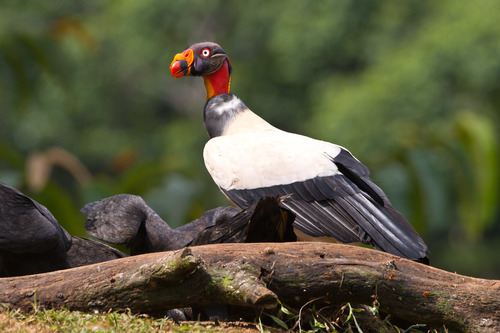
Excluding the two condor species, the king vulture (Sarcoramphus papa) is the largest New World vulture. Its total length measures 67 to 81 cm (26–32 in), its wingspan ranges from 1.2 to 2 m (4–7 ft), and its weight falls between 2.7 and 4.5 kg (6–10 lb). Adult king vultures are striking birds with mostly white plumage that carries a faint rose-yellow tint. In sharp contrast, the wing coverts, flight feathers, and tail are dark grey to black, matching the prominent thick ruff around the neck. The head and neck are featherless: the head's skin ranges in shade from red to purple, the neck is vivid orange, and the throat is yellow. The skin on the head is wrinkled and folded, and a distinct irregular golden crest grows on the cere above the bird's orange and black bill. This caruncle does not fully develop until the bird is four years old. Relative to its body size, the king vulture has the largest skull, largest braincase, and strongest bill among all New World vultures. The bill has a hooked tip and a sharp cutting edge. The species has broad wings and a short, broad, square tail. Its eye irises are white and edged with bright red sclera. Unlike some other New World vultures, the king vulture has no eyelashes. It also has grey legs and long, thick claws. The king vulture shows very little sexual dimorphism: males and females have identical plumage and only minor size differences. Juvenile king vultures have dark bills and eyes, and a downy grey neck that quickly begins to turn the orange color of adults. Young birds are overall slate gray; while they resemble adults by their third year, they do not fully molt into adult plumage until they are around five to six years old. Jack Eitniear of the Center for the Study of Tropical Birds in San Antonio, Texas studied the plumage of captive birds of different ages and found that ventral feathers begin turning white starting at two years of age, followed by wing feathers, until full adult plumage develops. The final immature stage is marked by scattered black feathers remaining in the otherwise white lesser wing coverts. The featherless head and neck is a hygiene adaptation: small black bristles are present on parts of the head, but the lack of full feathers keeps bacteria from the carrion the vulture eats from damaging its feathers, and exposes the skin to the sun's sterilizing effects. Dark-plumaged immature king vultures may be mistaken for turkey vultures, but they soar with flat wings. Pale-plumaged adults could be confused with wood storks, though wood storks' long necks and legs make them easy to identify from a distance. The king vulture occupies an estimated range of 14 million square kilometres (5,400,000 sq mi) stretching from southern Mexico to northern Argentina. In South America, it does not live west of the Andes, with the exceptions of western Ecuador, north-western Colombia, and far north-western Venezuela. It primarily lives in undisturbed tropical lowland forests, as well as savannas and grasslands located near these forests. It is often found near swamps or marshy areas within forests. Within its range, this bird is often the most common or only vulture present in primary lowland forests, but in the Amazon rainforest it is typically outnumbered by the greater yellow-headed vulture. In more open habitats, it is typically outnumbered by the lesser yellow-headed vulture, turkey vulture, and American black vulture. King vultures generally do not live above 1,500 m (5,000 ft), though they are found at up to 2,500 m (8,000 ft) altitude east of the Andes, and have been rarely recorded as high as 3,300 m (11,000 ft). They live in the emergent forest layer, above the tree canopy. Pleistocene remains of the king vulture have been found in Buenos Aires Province, central Argentina, over 700 km (450 miles) south of its current range. This find has led to speculation about the habitat that existed there at the time, which was previously thought not to have been suitable for the species. The king vulture soars effortlessly for hours at a time, only flapping its wings infrequently. When in flight, it holds its wings flat with slightly raised tips, and can appear headless from a distance when airborne. Its wing beats are deep and strong. Naturalist Marsha Schlee observed two instances of king vultures flying in tandem in Venezuela, and has suggested this may be part of courtship behaviour. Despite its large size and bright coloration, the king vulture is quite hard to spot when perched in trees. When perched, it holds its head lowered and thrust forward. It is non-migratory, and unlike turkey vultures, lesser yellow-headed vultures, and American black vultures, it generally lives alone or in small family groups. Groups of up to 12 birds have been observed bathing and drinking at a pool above a waterfall in Belize. Usually only one or two birds descend to feed at a carcass, though occasionally up to around ten may gather if there is a large amount of food. King vultures have lived up to 30 years in captivity, but a male transferred from the Sacramento Zoo to the Queens Zoo is over 47 years old. Vivian, a female king vulture at Cameron Park Zoo in Waco, Texas, turned 70 years old in 2022 and is the oldest known king vulture held in an AZA-accredited facility. The species' lifespan in the wild is unknown. The king vulture uses urohidrosis, defecating on its legs, to lower its body temperature. Despite its large size and powerful bill, it is relatively unaggressive at a feeding site. The king vulture does not have a voice box, though it can produce low croaking and wheezing sounds during courtship, and bill-snapping noises when threatened. Its only natural predators are snakes, which prey on the vulture's eggs and young, and large cats such as jaguars, which may ambush and kill an adult vulture at a carcass.