About Sarcops calvus (Linnaeus, 1766)
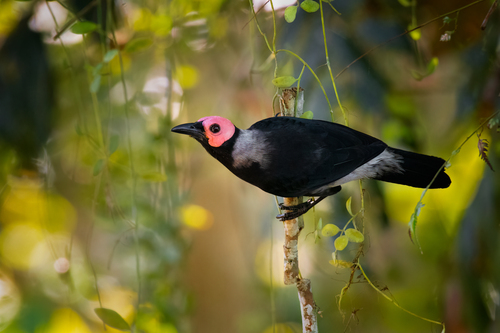
Sarcops calvus is a fairly large bird found in forest canopies and more open wooded areas from lowlands to low mountain elevations. It is often spotted on exposed snags. Its plumage is pale gray from the back of the neck down through the back, rump, and body sides; the rest of its underparts and wings are black, and most of its head is covered in bare pink skin, making it unmistakable. Its voice consists of a mixture of clicks, squeals, metallic warbling, and piping notes. In 1760, French zoologist Mathurin Jacques Brisson published a description of the coleto in his work Ornithologie, based on a specimen collected in the Philippines. He used the French name Le merle chauve des Philippines and the Latin name erula Calva Philippensis. While Brisson created these Latin names, they do not follow the binomial system and are not recognized by the International Commission on Zoological Nomenclature. In 1766, Swedish naturalist Carl Linnaeus updated his Systema Naturae for its twelfth edition, adding 240 species that had previously been described by Brisson—one of these was the coleto. Linnaeus included a brief description, coined the binomial name Gracula calva, and cited Brisson’s work. The specific name comes from the Latin word calvus, meaning 'bald' or 'without hair'. This species is now the only member of the genus Sarcops, which was introduced by English ornithologist Arthur Walden in 1875. The genus name combines the Ancient Greek words sarx, sarkos meaning 'flesh', and ōps, ōpos meaning 'face' or 'complexion'. This species inhabits primary and secondary forest and scrubland up to 1,000 meters above sea level. The IUCN has assessed this bird as a least-concern species, as it has a large range and is common throughout its range. However, ongoing deforestation across the Philippines is driven by slash-and-burn farming, mining, illegal logging, and habitat conversion. This bird is also widely caught for the pet trade, because it can copy human speech. Sarcops calvus feeds on fruit, berries, small insects, and nectar. It forages singly, in pairs, and occasionally in small groups of up to 25 individuals in fruiting trees. It breeds from March to September, nesting in cavities inside dead trees. Its typical clutch size is 2 to 3 eggs. In the Philippines, the coleto has recently been identified as a host of the brood parasitic Asian Koel (Eudynamys scolopaceus).