About Sarcophilus harrisii (Boitard, 1841)
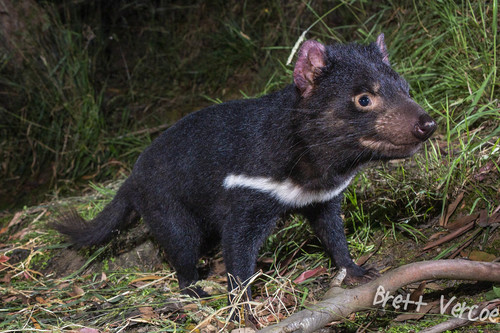
The Tasmanian devil (Sarcophilus harrisii) is the largest surviving carnivorous marsupial. It has a squat, thick build, a large head, and a tail about half its body length. Unusually for a marsupial, its forelegs are slightly longer than its hind legs. It can run up to 13 km/h (8.1 mph) on typical terrain and reach 25 km/h (16 mph) on flat roads for up to 1.5 km (0.93 mi). The fur is usually black, often with irregular white patches on the chest and rump, though about 16% of wild devils lack these patches. These markings may draw biting attacks to less vital body areas. Males are generally larger than females. Males have an average head - body length of 652 mm (25.7 in), a 258 mm (10.2 in) tail, and an average weight of 8 kg (18 lb), while females have an average head - body length of 570 mm (22 in), a 244 mm (9.6 in) tail, and an average weight of 6 kg (13 lb). Devils in western Tasmania tend to be smaller. Devils have five long toes on their forefeet (four forward - pointing and one from the side) for holding food, four - toed hind feet, and non - retractable claws. They have a relatively low centre of mass. Devils are fully grown at two years, and few live longer than five years in the wild. The longest - lived recorded was Coolah, a male that lived in captivity for over seven years. The devil stores body fat in its tail, and a healthy devil has a fat tail. The tail is mostly non - prehensile and is important for physiology, social behavior, and locomotion, acting as a counterbalance. An ano - genital scent gland at the tail base is used to mark the ground. The male has external testes in a pouch - like structure, and the female's pouch opens backwards and is present throughout her life. The Tasmanian devil has the most powerful bite relative to body size among living mammalian carnivores, with a Bite Force Quotient of 181 and a canine bite force of 553 N (124 lbf). Its jaw can open 75–80 degrees, enabling it to tear meat and crush bones. Its teeth and jaws resemble those of hyenas, an example of convergent evolution. Like all dasyurids, it has prominent canines and cheek teeth, with three pairs of lower incisors and four pairs of upper incisors. It has 42 teeth that grow continuously. It has long claws for digging burrows, seeking food, and gripping prey or mates. The large neck and forebody give it strength biased towards the front half, causing its lopsided gait. It has long whiskers on the face and head to locate prey and detect other devils. Hearing is its dominant sense, and it has an excellent sense of smell with a range of 1 km (0.62 mi). It has a well - defined, saddle - shaped ectotympanic. Since it hunts at night, its vision is strongest in black and white, better at detecting moving objects. The Tasmanian devil was once on mainland Australia but went extinct there 3,500 years ago, possibly due to the introduction of the dingo, increased human activity, or climate change. It is found in all habitats in Tasmania, including urban outskirts, and is distributed across the Tasmanian mainland and Robbins Island. The north - western population is west of the Forth River and as far south as Macquarie Heads. It was previously on Bruny Island but disappeared after 1900. It was illegally introduced to Badger Island in the mid - 1990s and removed by 2007. A study modeled reintroducing DFTD - free devils to the Australian mainland in areas with few dingoes. In 2015, 20 immunized captive - bred devils were released in Narawntapu National Park, but two died from being hit by cars. The 'core habitat' is in the low - to - moderate annual rainfall zone of eastern and north - western Tasmania. Devils prefer dry sclerophyll forests and coastal woodlands, open and dry forests, and are also found near roads with roadkill, though they are often hit by vehicles. Habitat modification is not a major threat. The devil is linked to the Dasyurotaenia robusta tapeworm, found only in devils. In late 2020, devils were reintroduced to mainland Australia in a New South Wales sanctuary, and joeys were born in 2021. The Tasmanian devil is a keystone species in Tasmania's ecosystem. It is a nocturnal and crepuscular hunter, spending days in dense bush or holes. Young devils are predominantly crepuscular, and there is no evidence of torpor. Young devils can climb trees, becoming more difficult as they grow. They can scale trees with a trunk diameter over 40 cm (16 in) up to 2.5–3 m (8 ft 2 in – 9 ft 10 in), shrubs up to 4 m (13 ft), and non - vertical trees to 7 m (23 ft). This climbing may help young devils escape adult devils. Devils can swim and cross 50 - m (160 - ft) rivers. They do not form packs and spend most time alone after weaning. A 2009 study showed they are part of a single social network, with male - female interactions during mating season and female - female interactions more common at other times. They are generally non - territorial, but females are territorial around dens. They occupy a home range of 4–27 km2 (1.5–10.4 sq mi) on average, with the area depending on food distribution. They use 3 - 4 dens regularly, with wombat dens prized as maternity dens. Adult devils use the same dens for life. Young pups stay in one den with their mother, while other devils change dens every 1–3 days and travel an average of 8.6 km (5.3 mi) per night, with a possible upper bound of 50 km (31 mi). They prefer lowlands, saddles, and creek banks, avoiding steep slopes and rocky terrain. The amount of movement is similar throughout the year, except for new mothers. Males and females travel similar distances, with males spending more time eating. Devils make circuits of their home range while hunting and may steal items for their dens near human habitation. In ambient temperatures between 5 and 30 °C (41 and 86 °F), the devil maintains a body temperature of 37.4–38 °C (99.3–100.4 °F). At 40 °C (104 °F) and 50% humidity, its body temperature spikes then returns to normal. It may dissipate heat through sweating or evaporative cooling, though a later study found it pants but does not sweat. The standard metabolic rate of a Tasmanian devil is 141 kJ/kg (15.3 kcal/lb) per day, much lower than smaller marsupials. A 5 - kg (11 - lb) devil uses 712 kJ (170,000 cal) per day, and the field metabolic rate is 407 kJ/kg (44.1 kcal/lb). It has a metabolic rate comparable to non - carnivorous marsupials of similar size. Devils lose weight from summer to winter but increase energy consumption. Their diet is protein - based with 70% water content. Females start breeding at sexual maturity, usually in their second year, and are fertile once a year, producing multiple ova in heat. The reproductive cycle starts in March or April to coincide weaning with food abundance. Mating occurs in sheltered locations in March, with males fighting over females. Females can ovulate up to three times in 21 days, and copulation can take five days. Devils are not monogamous. Females are selective to ensure good genetic offspring. Males may keep females in custody. Males can produce up to 16 offspring in their lifetime, and females average four mating seasons and 12 offspring. The pregnancy rate is high. Gestation lasts 21 days, and devils give birth to 20–30 young, each weighing about 0.18–0.24 g (0.0063–0.0085 oz). At birth, the front limb has well - developed digits with non - deciduous claws, the forelimb is longer than the rear limb, the eyes are spots, the body is pink, and there are no external ears or openings. The sex can be determined at birth. Young devils are called 'pups', 'joeys', or 'imps'. After birth, they compete to reach the pouch and attach to a nipple for 100 days. The female's rear - opening pouch makes it difficult to interact with young. The female has only four nipples, so no more than four babies nurse. More females survive than males, and up to 60% of young do not reach maturity. Milk replacements are used for captive - bred, orphaned, or diseased - mother - born devils. Inside the pouch, young devils develop quickly. The rhinarium becomes distinctive in the second week, ears become visible at 15 days, and open at around 10 weeks. Eyelids are apparent at 16 days, whiskers at 17 days, and lips at 20 days. They can make squeaking noises after eight weeks and open their lips at 10–11 weeks. Eyelids do not open for three months, but eyelashes form at around 50 days. They start growing fur at 49 days and have a full coat by 90 days. Their eyes open between 87 and 93 days, and they can release the nipple at 100 days. They leave the pouch 105 days after birth, weighing about 200 g (7.1 oz). They stay in the den for another three months, first venturing outside between October and December and becoming independent in January. During this time, they drink their mother's milk, which has more iron than placental mammals' milk. After leaving the pouch, they grow about 0.5 kg (1.1 lb) a month until six months old. Up to three - fifths of devils do not reach maturity. Juveniles are more crepuscular, giving the impression of a population boom in summer. Orphaned and captive - raised devils that engage with new experiences survive better.