About Sarcomelicope simplicifolia (Endl.) T.G.Hartley
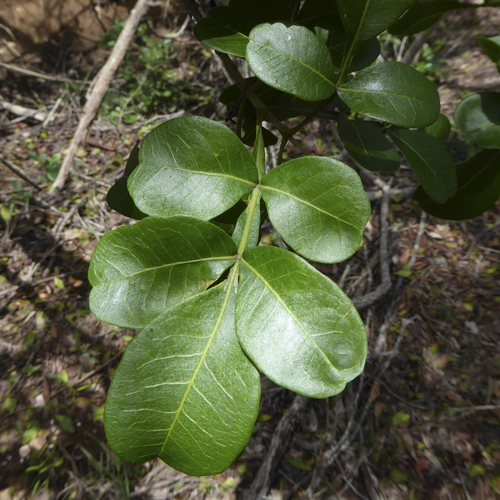
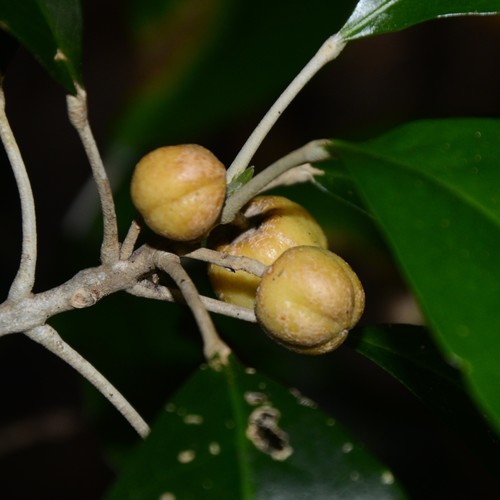
Sarcomelicope simplicifolia (Endl.) T.G.Hartley is a shrub or small tree that typically reaches a height of 18 metres (59 feet). It has a cylindrical trunk covered in corky, fissured bark. Its leaves are arranged in opposite pairs, and very rarely in whorls of three. They are shiny on the upper surface, paler on the lower surface, and have an elliptic to egg shape with the narrower end at the base. The leaves measure 30–170 mm (1.2–6.7 in) long and 20–70 mm (0.79–2.76 in) wide, growing from a petiole 10–50 mm (0.39–1.97 in) long. Flowers are grouped in small clusters 8–60 mm (0.31–2.36 in) long in leaf axils, and individual flowers are functionally either male or female. Male flowers are 3–3.5 mm (0.12–0.14 in) long and have eight stamens that alternate in length. Female flowers are 4–4.5 mm (0.16–0.18 in) long. Flowering occurs mainly from February to August. The fruit is a drupe 10–15 mm (0.39–0.59 in) long that contains seeds 5–7.5 mm (0.20–0.30 in) long. Two subspecies have different distribution ranges: Sarcomelicope simplicifolia subsp. simplicifolia grows in and on the margins of warmer rainforest, ranging from the Mount Carbine area in tropical north Queensland to Mount Dromedary in south-eastern New South Wales. It is also found on Norfolk Island and Lord Howe Island. Subspecies neoscotia occurs in New Caledonia and Vanuatu. The fruit of this plant is eaten by a range of bird species, including the green catbird and white-headed pigeon. For horticultural use, regenerating this species from seed is not easily done. To grow from seed, seeds must be removed from their fleshy fruit coating, then soaked for one to two weeks. Around half of the prepared seeds may develop roots and shoots after six months.