About Sarcodon squamosus (Schaeff.) Quél.
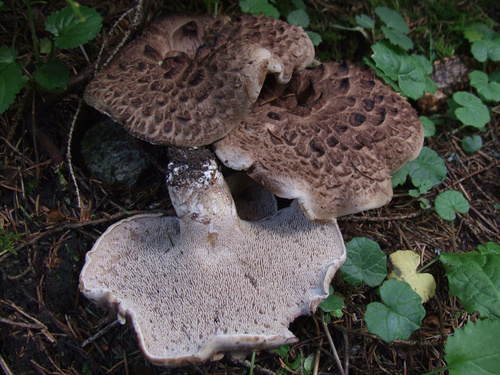
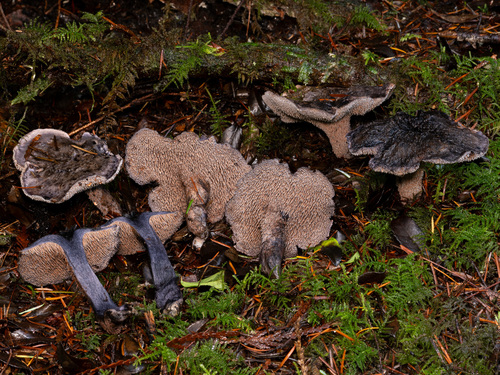
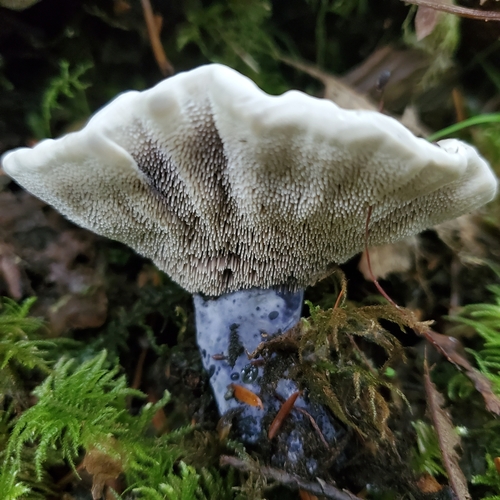
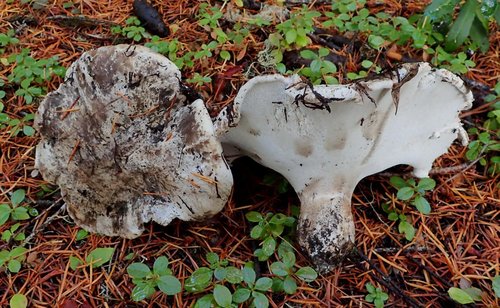
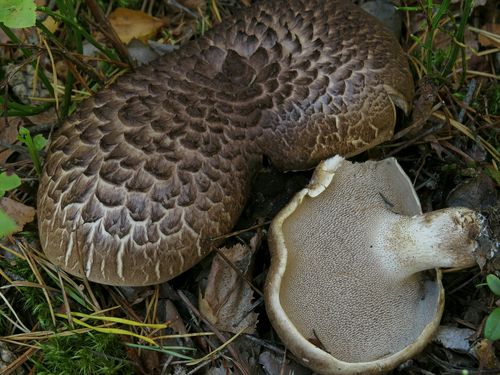
Sarcodon squamosus is an edible mushroom that was previously recognized as a subspecies of Sarcodon imbricatus. For many years, descriptions of S. imbricatus included fungi growing with both spruce and pine; pine-associated forms were smaller, and Norwegian mushroom hunters noted they were more palatable. DNA molecular analysis showed the two forms are genetically distinct. Populations previously classified as S. imbricatus from collections in the British Isles and the Netherlands are now assigned to Sarcodon squamosus. This mushroom often grows in large fairy rings near pine heaths, in rocky flat soil. Its cap ranges from 10 to 25 centimetres (4 to 10 inches) wide and is shallowly funnel-shaped. Young caps are white, turning brownish-purple with age. The pileipellis bears dark scales arranged in concentric circles. Sarcodon squamosus grows in areas with old trees where both forest type and growth pattern have long continuity, and it cannot survive complete forest felling. Young mushrooms have a pleasant smell and mild taste; older mushrooms may develop a bitter flavor. It can be cooked and mixed with other mushrooms, and stored in oil or cider vinegar. It is notable for mushroom dyeing as one of the only mushroom species that produces blue dye shades. Young mushrooms yield brown shades, while older, nearly mature mushrooms produce rarer blue, turquoise, and green shades.