About Sarcandra glabra (Thunb.) Nakai
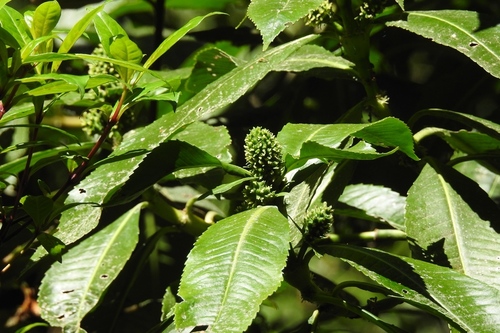
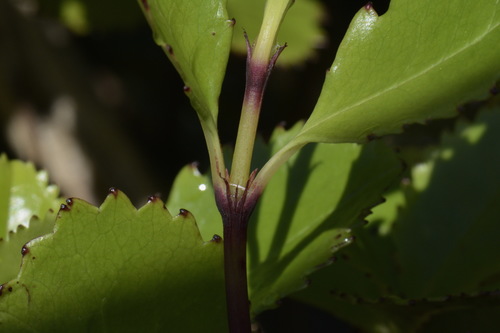
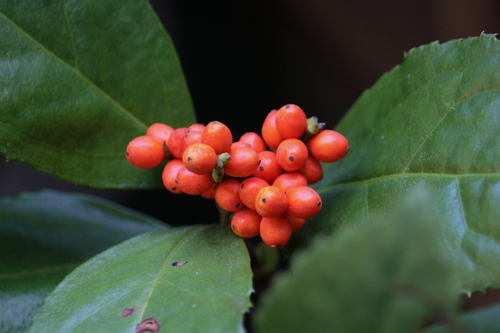
Morphology: The leaf blade of Sarcandra glabra is elliptic or ovate-lanceolate, measuring 6–17 cm long and 2–6 cm wide, with a leathery texture and sharply coarsely serrated margins. The stamen ranges from baculate to terete, and its thecae are shorter than the connective. The stigma is subcapitate. The fruit is globose or ovoid, with a diameter of 3–4 mm.
Distribution: Sarcandra glabra is distributed in Vietnam, Sri Lanka, Taiwan, Cambodia, Malaysia, India, Japan, Korea, the Philippines, and multiple regions of China including Jiangxi, Anhui, Fujian, Guizhou, Guangxi, Hong Kong, Hunan, Sichuan, Yunnan, Guangdong, and Zhejiang. It grows at altitudes between 420 meters and 1,500 meters, and is most often found on wet slopes and in shaded valleys.
Use in Japanese culture: This plant is used for chabana decoration during Japanese New Year, typically arranged alongside winter jasmine. Coralberry trees and Ardisia japonica are often used as substitutes for Sarcandra glabra due to their similarity in appearance to it.