About Sapria himalayana Griff.
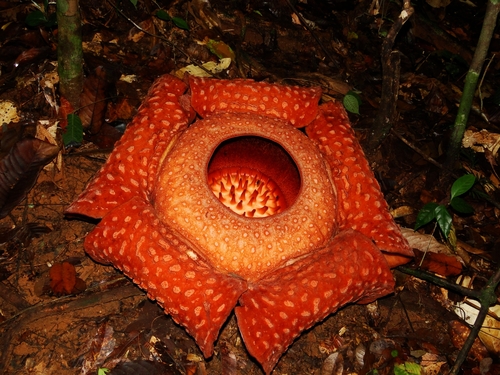
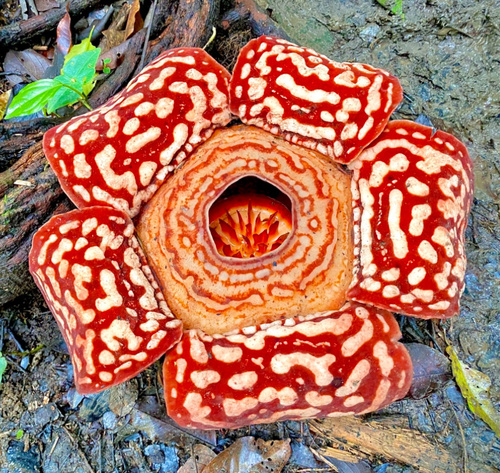
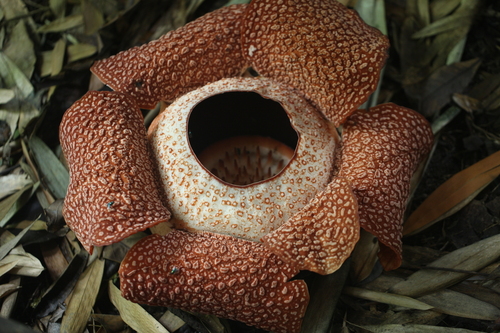
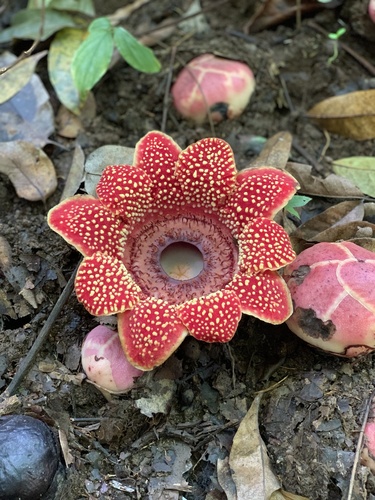
Sapria himalayana Griff. is a parasitic plant whose only visible aboveground part is its short, erect, unbranched flowering shoot, which grows from a globose vegetative body that remains underground attached to host plant roots. Sapria himalayana is a root parasite that typically parasitizes liana hosts from the genera Vitis and Tetrastigma. Its flowers are around 20 centimeters across, are dioecious and unisexual, and are fleshy with imbricate arrangement. Each flower has 10 bracts, is bright red covered with sulfur-yellow spots, emerges above ground, blooms for 2 to 3 days, and produces a putrid odor. The perianth of the flower is campanulate. Male flowers have broadly ellipsoid 2-loculed anthers that dehisce via apical pores; they have a convex base to the apical cupular body, and their gynostegium is blood red. Female flowers have a concave cupular body base, bear sterile stamens, and their gynostegium is stouter than stamens. Flowering and fruiting occurs between December and February. After blooming, the flower splits open, darkens in color, and then slowly decomposes. Mature fruits are swollen and crowned by the persistent perianth. Seeds are as large as a grapefruit, and are blackish-brown. Flies have been proposed as pollinators, and rodents as possible agents of seed dispersal, but neither claim has been confirmed by direct observation. This species naturally grows in evergreen forests at altitudes between 800 and 1,450 meters. In India, it has been recorded in Namdapha National Park in Northeast India. Historical records note it from other Northeast Indian locations: the Mishmi Hills, Aka Hills in Arunachal Pradesh, and the states of Assam, Manipur, and Meghalaya, though there have been no recent confirmed records from these areas. In 2020, a villager tracking through jungle near the village of Khunbi (Yulli), Tengnoupal District, Manipur (a district neighboring Myanmar) spotted the species. Recently, it was also spotted in the hills of Perlek Modi, West Siang District, Arunachal Pradesh by Dr. Jayom Karlo, an amateur researcher and child specialist by profession. In Thailand, the species occurs in Doi Suthep National Park, Doi Inthanon, Doi Phu Kha National Park, Thung Yai Naresuan Wildlife Sanctuary, and Kaeng Krachan National Park in the Tenasserim Hills. In Myanmar, it is found in the Dawna and Karen Hills. In Vietnam, the species is only known from the Lang Biang Plateau, where it has been recorded at Tuyền Lâm Lake, the Nam Ban Protection Forest, and the Cam Ly area.