About Sapium glandulosum (L.) Morong
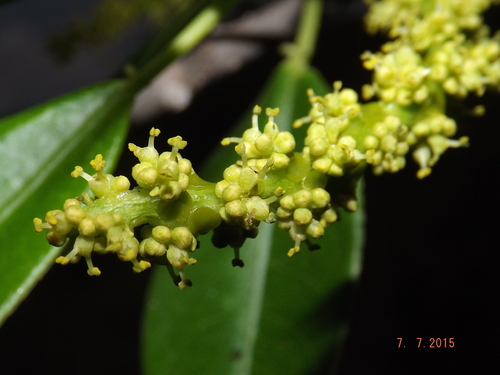
Sapium glandulosum is a tree species belonging to the family Euphorbiaceae. It is native to the Neotropics, ranging from Mexico and the Caribbean south to Argentina, and has been cultivated in other regions. It is the most common species in the Sapium genus. Its common names include gumtree, milktree, leche de olivo, and olivo macho. This tree can grow up to 30 meters tall, and usually develops some buttress roots and multiple trunks. Smaller woody parts of the tree may have short, thick spines. It has thin, patchy outer bark that peels and leaves scars, and a granular inner bark. It produces large quantities of milky latex. Its alternately arranged leaves are toothed, oblong or oval, and can reach up to 27 centimeters long and 8 centimeters wide. New leaves have teeth tipped with glands. This species is monoecious. Its inflorescence is a spike-shaped structure that holds clusters of male flowers, with a small number of female flowers located at the base. The tiny, rounded purple male flower is just barely over one millimeter long. The female flower has 3 styles that are approximately 2 millimeters long. The fruit is a greenish-brown, rounded capsule that grows up to one centimeter long, and splits into 3 segments, each containing one seed. Each seed is covered in a thin layer of red pulp. This tree grows in tropical moist and wet forests. The large volume of latex it produces is high quality and can be used to make rubber, but it is difficult to harvest, so it has no commercial use.