About Sapajus robustus (Kuhl, 1820)
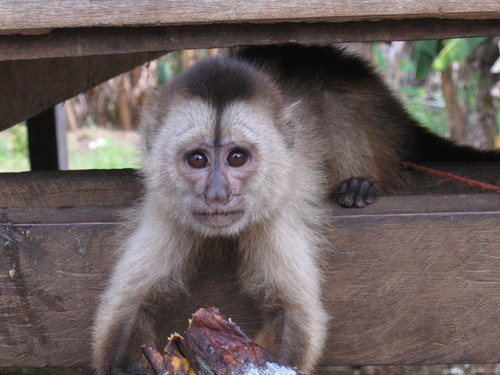
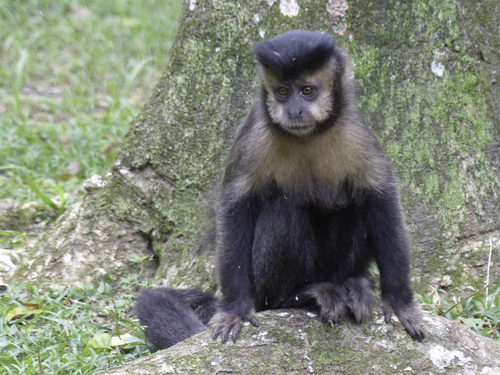
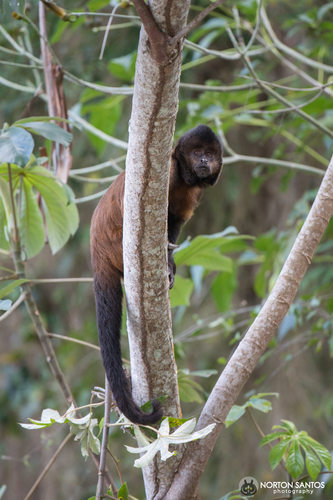
The crested capuchin (Sapajus robustus) can be distinguished from other capuchin species by a bright red conical crest on its crown that features a black spot. This crest may extend around the sides of the head to form a black beard. The rest of the species' fur is typically brownish red or yellowish brown. The forearms, lower legs, and tail are all black; in females, these areas can instead be a mix of black and light yellow fur. Females may also have two lateral tufts on the crown that are not present in males. Head-body length for crested capuchins ranges from 33 to 57 centimetres (13–22 in), and tail length ranges from 40 to 47 centimetres (16–19 in). Males of the species are generally larger than females, and overall body weight ranges from 2.0 to 3.8 kilograms (4.4–8.4 lb).
Crested capuchins historically occupied the Atlantic coast of Brazil between the Doce and Jequitinhonha rivers, in the states of Espírito Santo, Minas Gerais and Bahia. Due to habitat loss, the species' current range is now restricted to Bahia, eastern Minas Gerais, in the area south of the Jequitinhonha River and north of the Doce River. The species typically occupies the mid-canopy to understory of tropical lowland and sub-montane forests, but can also be found in semi-deciduous dry forests in the western portion of its range.
Crested capuchins have a broad diet that includes fruits, seeds, arthropods, frogs, and even small mammals. They are very skilled at manipulating food items to access the edible parts they want. No tool use has been formally recorded for crested capuchins, but it is very possible that the species does use tools. Better-studied robust capuchin species such as the black capuchin are documented to use stones to open hard-shelled fruits and oysters. Given similarities between these species and their overlapping ranges, crested capuchins may use tools in the same way. No specific observations of crested capuchin social structure have been made, but the species likely lives in mixed-sex linear hierarchies similar to other closely related capuchin species. In this structure, the top-ranking male dominates the top-ranking female. Lower-ranked males stay within the group, but usually remain at the group's periphery.