About Sapajus cay (Illiger, 1815)
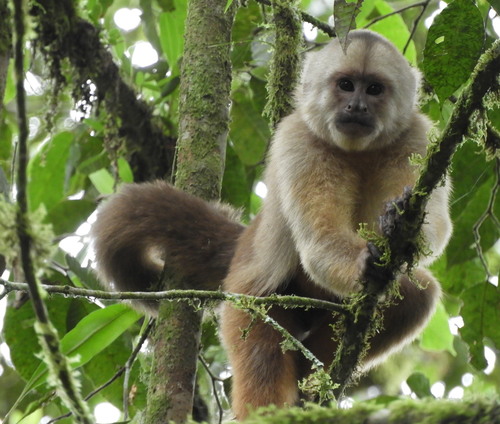
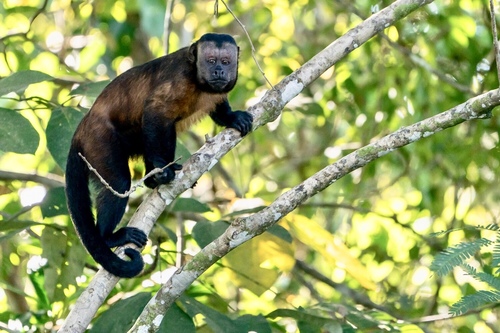
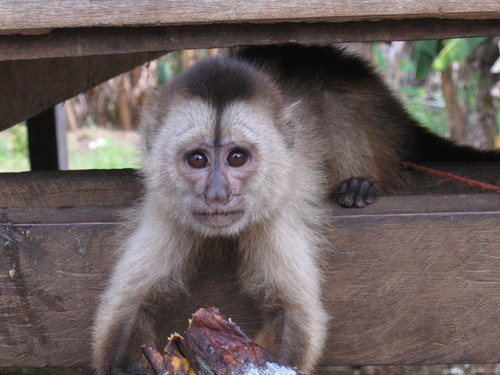
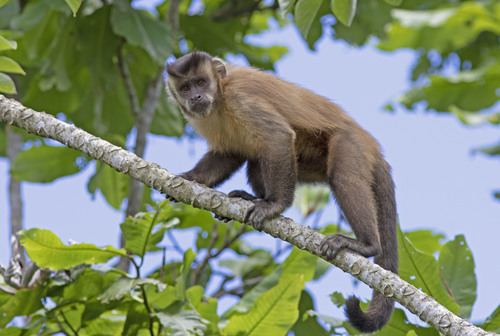
Azara's capuchin monkey, scientifically named Sapajus cay (Illiger, 1815), is classified as one of the tufted capuchins. Its characteristic tuft only fully develops after the individual reaches adulthood. Females reach sexual maturity at 4 to 5 years old, while males reach sexual maturity around 8 years old. In captivity, individuals of this species can live up to 50 years, while the average lifespan in the wild is around 30 years. This species shows slight sexual dimorphism, with males growing to a larger body size than females. Females weigh between 1.4–3.4 kg (3.1–7.5 lb), and males weigh between 1.3–4.8 kg (2.9–10.6 lb). The average nose-to-tail height of an adult male is 0.8m, and females are slightly shorter. They have long feet and long tails; their tails can reach half the length of their total body height. According to Silva, S. cay can be distinguished from other species in the Sapajus genus by its significantly smaller cranium size, even in adulthood. They typically have medium-length fur that displays multiple different brown tones across the body. Their limbs and tuft are usually a darker color than the rest of the body. Compared to other Sapajus species, S. cay has a dark stripe of hair on the front of its ears that looks similar to sideburns. There has been substantial disagreement about the true taxonomic classification of this species, due to its high morphological variability. S. cay shows inter-population and intra-population polymorphism, as well as sexual dimorphism, and undergoes significant morphological changes across different life stages. Members of the Cebus and Sapajus genera, which include capuchin monkeys, generally live in the tropical and subtropical forests of South and Central America. While the group occupies a wide overall range, the current population of S. cay only resides across nearly 200 hectares (around 500 acres) of territory. The general habitat of capuchin monkeys is hot and humid year-round, with high annual precipitation and dense vegetation. S. cay has high behavioral and ecological flexibility, which allows it to live in a wide range of habitats, including bushlands and savannas. The distribution of S. cay covers northern Argentina, southeastern Bolivia, and eastern Paraguay. It also inhabits Brazil, where it is found southwest of the Amazon, approximately south of the states of Mato Grosso and Mato Grosso do Sul, as well as southeast of Goiás state. Some populations of S. cay live in the Jujuy, Salta, Formosa and Chaco provinces of northern Argentina. S. cay is the only representative of its genus established in Paraguay, where it occurs in the humid semi-deciduous Alto Parana Atlantic Forest. S. cay is diurnal, opportunistic, omnivorous, and lives in social communities. Individuals travel throughout their territory to search for food. Research shows these capuchins spend most of their time resting, travelling, and foraging. While there are significant differences between male and female behavior, there are not many significant differences between male and female diet.