About Sapajus apella (Linnaeus, 1758)
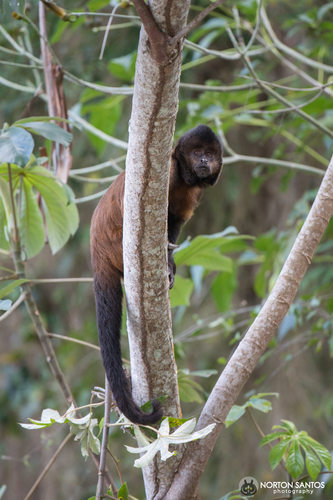
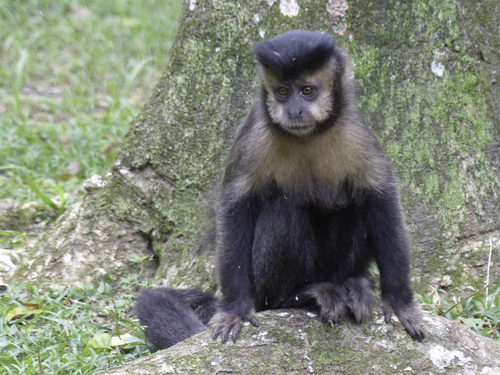
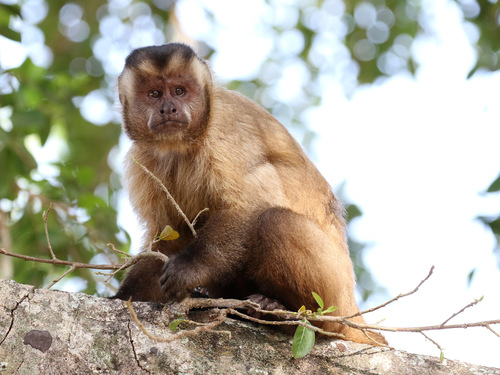
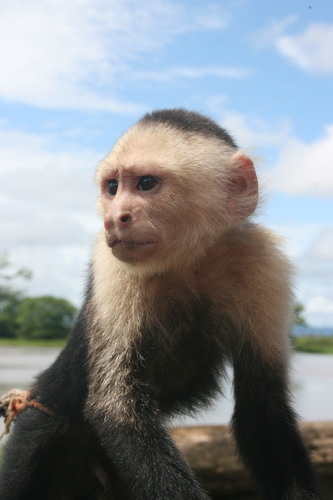
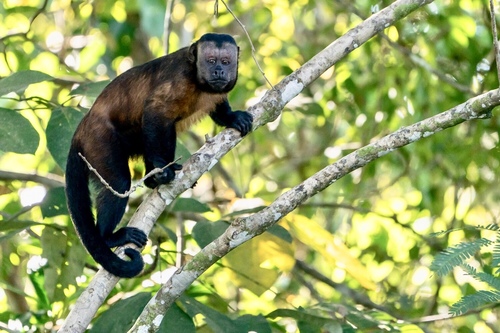
Physical characteristics: The tufted capuchin (Sapajus apella) is more powerfully built than other capuchins, with rougher fur and a long, thick tail. It has a bundle of long, hardened hair on its forehead that can be raised like a "wig". Its fur is brownish gray, with a belly that is somewhat lighter than the rest of the body, and black hands and feet. The tail is prehensile: it is strong and can be used for grasping, acting as an extra limb. The tufted capuchin has a head-body length of 32 to 57 centimetres (13 to 22 in), a tail length of 38 to 56 centimetres (15 to 22 in), and a weight of 1.9 to 4.8 kilograms (4.2 to 10.6 lb), with males generally larger and heavier than females. Distribution and habitat: This species lives in the northern Amazon rainforest of the Guyanas, Venezuela and Brazil, west of the Rio Negro, and as far north as the Orinoco in Venezuela. It is also found in eastern Colombia, Ecuador, Bolivia, and Peru, including the upper Andean Magdalena valley in Colombia. An introduced breeding population is well established on the northwestern peninsula of the island of Trinidad, in the Republic of Trinidad and Tobago. The subspecies/population on Margarita Island in Venezuela, S. a. margaritae, is classified as Critically Endangered on the IUCN Red List. It can be found in a large variety of forest types, mainly in tropical rainforests (up to an elevation of 2700 m), but also in more open forests. Its distribution overlaps with that of other capuchin species, such as the white-fronted capuchin (Cebus albifrons). Behaviour and ecology: The tufted capuchin is a diurnal, arboreal primate species, but it often forages on the ground and walks longer distances between trees that are too far apart to jump between. Tufted capuchins live in groups of two to twenty or more animals. A single group usually contains at least one adult male, and some groups have multiple males. When multiple males are present, one male is dominant. The dominant male only allows a small number of monkeys near him, mainly younger individuals and a few females. During periods of food scarcity, the dominant male and his close group members have priority to eat first, while subordinate monkeys must wait until they have finished. After a 180-day gestation period, one young is born, occasionally twins. The newborn weighs only 200 to 250 grams (7.1 to 8.8 oz), and is carried on its mother's back. The mother nurses her young for 9 months, but young tufted capuchins do not reach sexual maturity until their seventh year, which is quite late for a primate of this size. Important natural predators of the tufted capuchin are large birds of prey. They are so afraid of these birds that they become alarmed even when a harmless bird flies overhead. Tool use and manufacture: Tufted capuchins have been observed using containers to hold water, sticks for digging nuts, dipping for syrup, catching ants, and reaching food, sponges to absorb juice, stones as hammers and chisels to penetrate barriers, and stones as hammers and anvils to crack nuts. While some of these tasks are relatively simple by cognitive standards (for example, using a stick to catch ants), others, such as cracking nuts with a hammer and anvil, are only exceeded in complexity by chimpanzee tool use. The likelihood of tool use in a species like the tufted capuchin depends on a number of conditions. Van Schaik proposed that tool use is likely to occur in foraging species if three factors are present: manual dexterity, intelligence, and social tolerance. For manual dexterity, capuchins are capable of a limited precision grip — the ability to delicately pinch and manipulate objects with the thumb and fingertips. This ability is not found in any other New World monkeys, and only present to a limited degree in apes. S. apella has an encephalization ratio greater than non-human hominids, and a neocortex ratio almost as large as that of apes; both are rough indicators of high intelligence. Finally, the tufted capuchin forms social groups typical of a complex and tolerant society. The tufted capuchin has been observed manufacturing tools both in captivity and in the wild. In captivity, it has been reported to make probing sticks to reach syrup in normally inaccessible containers. It can also understand the concept of "sponging", using paper towels, monkey biscuits, sticks, leaves and straw to sop up juice, then suck on the sponge to consume the juice. Wild research shows that capuchin tool use is just as extensive in the wild as in captivity; capuchins have been observed using stones to dig holes to access tubers, an activity previously only recorded in humans. The practice of using stones to crack nuts has arisen spontaneously in many locations hundreds of miles apart, such as the Caatinga Dry Forest and Serra da Capivara National Park, all in Brazil. They have been observed cracking various nuts and fruits including palm nuts (Attalea and Astrocaryum spp.) and jatobá fruits (Hymenaea courbaril). Tufted capuchins have even been observed using stones to dislodge other stones that are later used as hammers or shovels, an example of the complex behavior known as second-order tool use previously only documented in chimpanzees. Curiously, not all tufted capuchins engage in tool use. Moura and Lee (2004) suggest lack of other food sources is the key factor. Ottoni and Mannu (2001), Fragaszy et al. (2004) and Visalberghi et al. (2005) have proposed this is more likely tied to the monkey's terrestrial habits: the more time a monkey spends on the ground, the more likely it is to benefit from, and thus engage in, tool use. In captivity, tufted capuchins have been observed manufacturing stone tools that produce simple flakes and cores. Some capuchins even use these sharpened stones to cut (in a back-and-forth motion) barriers to reach food. This behavior is important because it provides evidence of a mechanical tendency to modify stones using behaviors already in the monkeys' existing behavioral repertoires, and this behavior is considered a precursor to stone-knapping. This early, limited tool use has been hypothesized to be similar to tool use of pre-Homo habilis, and it is thought that artifacts from that period would probably resemble those made by capuchins. S. apella tool manufacture and use has been analyzed for potential clues to social learning and problem solving ability, as tool manufacture and use can often shed light on these complex cognitive abilities. Social learning, the ability to learn from other individuals, is a controversial topic in most non-human species including S. apella, because it is relatively difficult to determine whether a behavior was learned from imitation or a much simpler form of social learning. One way to narrow the gap between concurrent tool-related behaviors and their likelihood of arising from imitation is by narrowing down events that make social learning more probable, such as a preference for observing experienced tool users. In this regard, Ottoni and his team found that young capuchins tended to observe the best tool users when cracking nuts. Another way to distinguish imitation from simpler learning behaviors is to present capuchins with a box that holds food but has two different opening methods, with neither method being more advantageous than the other so that the monkey can freely choose either. In one such study, when humans opened the box in front of the monkeys using only one method, the monkeys used that method even when they discovered the alternative on their own. In another study, dominant capuchins from two separate groups were trained to open the box door in a specific way, after which the dominant capuchins were paired with subordinates that learned to open the door the same way. When capuchins trained this way are released back into their original groups, the habit spreads to all group members even when other alternative methods are discovered. Even so, the question of whether or not S. apella learns by imitation remains controversial, due to the inherent difficulty of finding unambiguous evidence of the complex cognitive process of imitation.