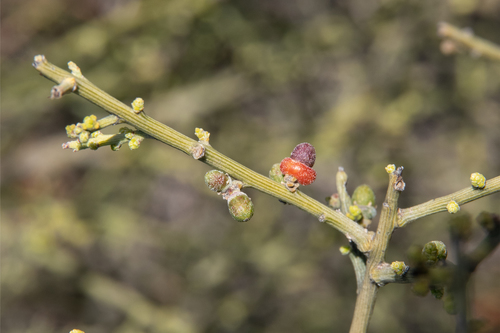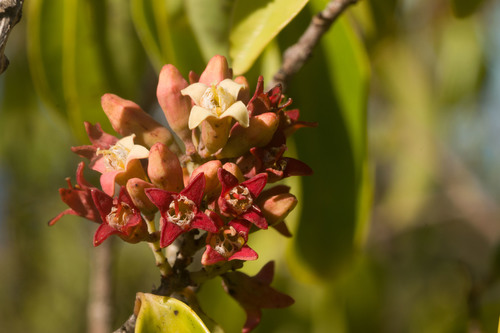
About Santalum freycinetianum Gaudich.
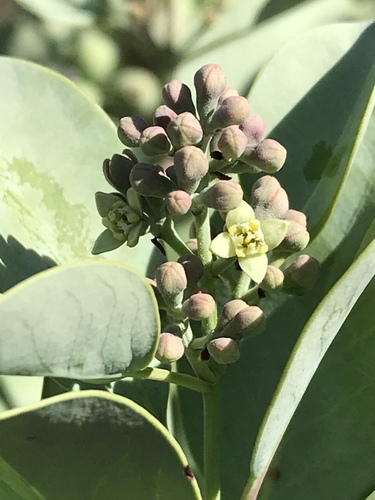
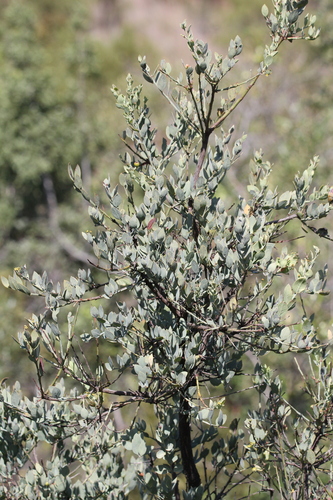
Santalum freycinetianum, commonly called forest sandalwood, Freycinet sandalwood, or ʻIliahi, is a species of flowering tree in the Santalaceae (European mistletoe) family that is endemic to the Hawaiian Islands. Its binomial scientific name honors Henri Louis Claude de Saulces de Freycinet, a 19th-century French explorer. ʻIliahi grows in dry forests, coastal mesic forests, mixed mesic forests, and wet forests on the Hawaiian islands of Oʻahu, Kauaʻi, Lānaʻi, Maui, and Molokaʻi, at elevations between 250 and 950 m (820 and 3,120 ft). It thrives in areas that get 500 to 3,800 mm (20 to 150 in) of rainfall per year. Like other species in the Santalum genus, ʻiliahi is a root hemi-parasite, meaning it obtains part of its nutrients from a host plant. Common host species for ʻIliahi include koa (Acacia koa), koaiʻa (Acacia koaia), and ʻaʻaliʻi (Dodonaea viscosa). The aromatic heartwood of ʻiliahi, called ʻlaʻau ʻala, contains valuable essential oils. Native Hawaiians used the wood to construct pola, the deck of a waʻa kaulua (double-hulled canoe). Powdered ʻlaʻau ʻala was used as a perfume and added to traditional kapa cloth. From 1791 to 1840, ʻiliahi trees were harvested intensely for export to China, where the hard, yellowish-brown heartwood was used to make carved objects, chests, and incense. The ʻiliahi trade reached its peak between 1815 and 1826, and ended once no large mature trees remained. In traditional Native Hawaiian medicine, practitioners combined ʻiliahi leaves and bark with ashes from naio (Myoporum sandwicense) to treat kepia o ke poʻo (dandruff) and liha o ka lauoho (head lice). A mixture of ʻIliahi shavings, ʻawa (Piper methysticum), nioi (Eugenia reinwardtiana), ʻahakea (Bobea spp.), and kauila (Alphitonia ponderosa) was used to treat sexually transmitted diseases.