About Santalum album L.
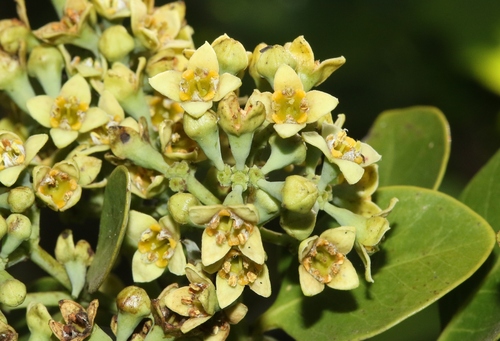
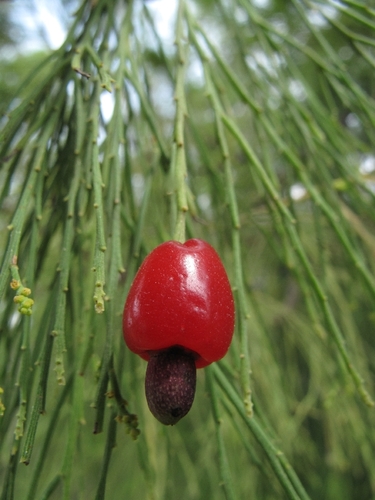
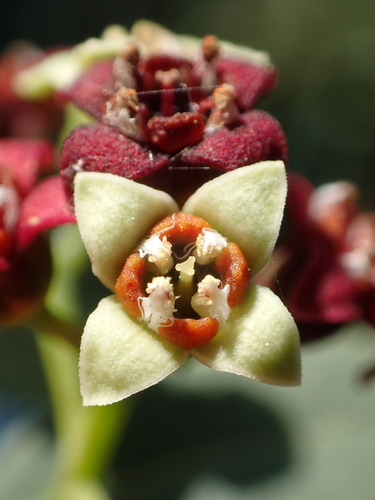
Santalum album L., commonly called white sandalwood, is an evergreen tree that grows 4 to 9 meters (13 to 30 feet) tall. Its growth habit is variable, usually ranging from upright to sprawling, and it may grow intertwined with other plant species. This tree is a root parasite, with a specialized root adaptation called a haustorium, and it does not cause major harm to its host plants. Individual Santalum album trees form non-obligate parasitic relationships with multiple other plant species; up to 300 species (including Santalum album itself) can act as hosts, supplying the tree with macronutrients (phosphorus, nitrogen, and potassium) and shade, especially during its early developmental stages. During early growth, Santalum album can propagate through wood suckering, forming small stands. Its bark ranges from reddish or brown to nearly black; it is smooth on young trees, and becomes cracked with age, revealing red tissue underneath. As its common name suggests, its heartwood ranges from pale green to white. Its leaves are thin, oppositely arranged, and shaped ovate to lanceolate. The leaf surface is glabrous, shiny, and bright green, with a pale glaucous underside. The tree produces fruit after three years of growth, and produces viable seeds after five years; seeds are distributed by birds. Santalum album is originally native to dry areas of Indonesia (Java and the Lesser Sunda Islands), the Philippines, and Western Australia, where it grows alongside closely related species. It was introduced to the Dravidian regions of South Asia as early as around 1500 BCE via the Austronesian maritime spice trade, along with other Austronesian domesticated plants including areca nut and coconut. The earliest archaeological evidence of Santalum album in South Asia dates to 1300 BCE in the southern Deccan, and it later became naturalized in regions with common dry sandy soils. Today, Santalum album is cultivated in India, Sri Lanka, Indonesia, Malaysia, the Philippines, and Northern Australia. Santalum album grows from coastal dry forests up to 700 meters (2,300 feet) in elevation. It normally grows in sandy or well-drained stony red soils, but can inhabit a wide range of soil types. Its natural habitat has an average temperature range of 0 to 38 °C (32 to 100 °F) and annual rainfall between 500 millimeters (20 inches) and 3,000 millimeters (120 inches). It can reach a maximum vertical height of 9.1 meters (30 feet). It requires full sunlight for planting and does not need large amounts of water. The tree begins flowering after seven years of growth; flowers are white on young trees and turn red or orange as the tree ages. The trunk develops its characteristic fragrance after around 10 years of growth, but the tree is not ready for harvest until 20 years of age. Santalum album rarely lives more than 100 years. Santalum album has long been the primary source of sandalwood and sandalwood essential oil, and these products hold an important place in the societies of its naturalized range. Only the heartwood, the central part of the tree, contains the characteristic fragrance. The heartwood is yellow-brown, hard, and has an oily texture; its durability makes it a preferred material for carving. The outer sapwood is unscented, white or yellow in color, and is used to make turned wood items. Due to the high value of sandalwood, cultivation attempts have expanded the plant's distribution range. Historically, it was valued for construction because it was considered rotproof. The first commercial extraction of Santalum album essential oil took place in Mysore, India in 1917. For many years after, oil extraction was carried out in perfumeries in Grasse, France. Today, production in India is controlled by the state, and global demand exceeds supply. The International Organization for Standardization has published the standard ISO 3518:2002 that outlines accepted characteristics for this essential oil. HPTLC, GC, and GC-MS methods are used for qualitative and quantitative analysis of the oil's volatile constituents. White sandalwood essential oil has a high santalol content of around 90%, which is much higher than the other main commercial source, the cheaper Australian sandalwood (Santalum spicatum), which has around 39% santalol. India historically dominated global sandalwood oil production, but the industry has declined in the 21st century. Another commercial source of sandalwood oil is Santalum austrocaledonicum from New Caledonia. Santalum album oil is an ingredient in the 1989 Guerlain perfume Samsara. The long maturation period and difficulty of cultivation have limited large-scale planting. Harvesting the tree requires multiple curing and processing stages, which further increases its commercial value. The wood and oil are in high demand and are important trade items in three main regions.