About Santalum acuminatum (R.Br.) A.DC.
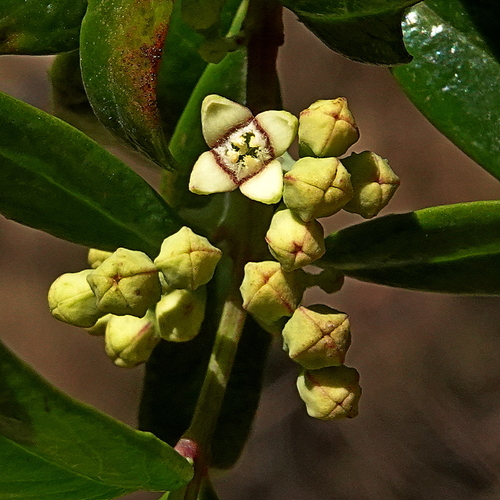
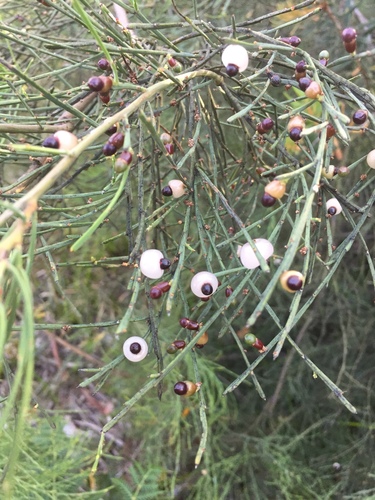
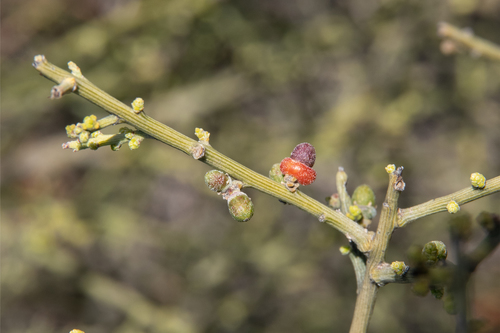
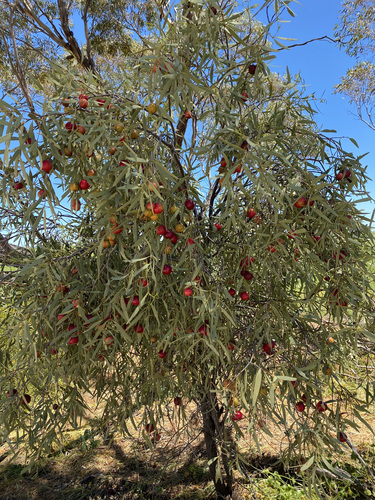
Santalum acuminatum (R.Br.) A.DC. grows as a tall shrub or small tree, reaching 4 to 6 m (13 to 20 ft) in height and 2–4 m (6.6–13.1 ft) in width. It has dark grey rough bark, and its branches are ascending in growth habit. Smaller plants produced by root suckers are sometimes found growing around larger specimens, and smaller branches have a more weeping habit. Its leaves are slender to ovate, pointed at the tip, and pale yellowish-green, giving them a slightly grey, leathery appearance. Leaves are borne on short petioles 5–10 mm long, with the leaf blades themselves measuring 45–115 mm long. Leaves are tapered in outline and arranged in opposite pairs on branchlets. Its flowers are green or creamy white on the outer parts, and reddish or yellowish brown on the inner faces. Flowers appear on stems, measure just 2–3 mm across, and are fragrant. Fruit production begins after 4 years of growth; the fruit is red or occasionally yellow, measuring 20 to 25 mm across. A 3-mm layer of flesh covers a brain-like nut with a hard shell that encloses the seed. This fruit type is classified as a drupe. It ripens from green to shiny red in late spring or summer, is globe-shaped, and can range from 20 to 40 mm across. The fruit skin has a waxy texture. This species is hemiparasitic via root adaptations: it produces haustoria that can extend roots 10 m to reach other plants' root systems. Like other members of the Santalum genus, it can perform photosynthesis, but obtains nutrients other than sugars from the root systems of host plants. Santalum attaches to host species in a non-destructive way, gaining nitrogen, water, and shade from its hosts. The roots have pad-like structures that nearly encircle the host's root, a trait typical of sandalwood genera. Hosts may be other trees or grasses, and individuals usually use multiple host plants. Recorded host genera include Acacia, Maireana, Atriplex, and many others, including other hemiparasites such as Exocarpos sparteus. This hemiparasitic mechanism allows the plant to acquire 70% of its nitrogen, as well as part of its required water, from other trees and shrubs. Santalum acuminatum is widely distributed across most southern regions of mainland Australia, including the arid centre of the country, and is common in some regions. The related Australian sandalwood, Santalum spicatum, was once more abundant than this species, but commercial exploitation has reversed this population relationship. In Western Australia, its range extends north to Carnarvon and Karratha (21°N), reaches inland from the coastal plains, and covers all of Southwest Australia. Few recorded specimens exist in this region, and the species is mainly restricted to coastal sandplains, as its range has been affected by changed land use in the wheatbelt. As with many regional species, some populations are discontinuous across the species' range, occurring beyond the natural seed dispersal range. Remote groups of the species are remnants of former broader distribution ranges that supported different climates, and these remnants may be isolated by hundreds of kilometres. This species is one of several regional species that includes "wet outliers" – small populations located outside the species' typical low-rainfall habitat. Populations have also been recorded in South Australia, Victoria, New South Wales, and Queensland. It is widespread in western New South Wales, reaching east to Dubbo and Culcairn, and is rare in the northwest of the state. This species occupies a diverse and widespread range of habitats, including creek beds, granite outcrops, gravel plains, and sandy dunes. It is tolerant to drought, salt, and high temperatures, and does not require a nutrient-rich growing environment. Seedlings can establish in the shade of their host plant, and grow toward full sun once developed, so the species is usually found intermingled with host plants and other species. The areas within its distribution range experience frequent bushfires, so the species relies on root regeneration to recover. As a result, it is rarely found as a mature advanced tree. Specimens exposed to bushfire and soil disturbance grow as sprawling multistemmed shrubs. Because the species can regrow from its root system, it outcompetes shrubs that must resprout from seed after fire. Single-stemmed trees only occur in locations that are not affected by frequent fire or soil disturbance. The foliage of Santalum acuminatum is much paler than that of other local trees and shrubs, making the plant easy to spot in bushland and scrub. An undisturbed mature specimen is recorded at Woodman Point in Western Australia, an area removed from the high-intensity fire regimes caused by human land modification. Emus eat the fruit of Santalum acuminatum, and it forms an important part of their diet. The nut remains undigested and is excreted in emu droppings, which is the primary method of seed dispersal for this species within the emu's range. A number of other species interact with Santalum acuminatum in complex relationships; a well-documented example is Paraepermenia santaliella, the quandong moth of the family Epermeniidae. Other insects, such as nitidulid beetle larvae and larvae of the wood white butterfly, also feed on Santalum acuminatum. The fruit and nut of Santalum acuminatum were important food sources for Indigenous peoples of arid and semiarid central Australia, especially for the fruit's high vitamin C content. Commercial cultivation and marketing as a bush food began in the 1970s, and the fruit is sometimes made into jam. It is widely known as an exotic food. Commercially, the fruit is added to both sweet and savoury foods; it has a tart flavour reminiscent of peach, apricot, or rhubarb. In South Australia, it is commonly called "wild peach" or "desert peach". The fruit and nut of this plant were featured in a bushfood series of stamps produced by Australia Post. It is well known as an exotic food in international markets, and export sales greatly exceed domestic consumption within Australia. The fruit also has free radical-scavenging ability. Most commercial supply has traditionally been sourced from wild trees, often harvested by Aboriginal corporations, though commercial orchards are currently being trialled for long-term viability. Many Aboriginal groups gathered the fruit, and most frequently harvested the nuts; undigested nuts can be easily collected from emu droppings. Food Standards Australia New Zealand has identified, analysed, and monitored the kernel as a "wild-harvested Australian indigenous food", and found the product is very high in fats, making up over half its weight. Indigenous peoples native to the species' range used the vitamin-C rich fruit and the complex-oil-containing nut kernel for medicinal purposes. Like all Santalum species, the wood (especially the roots) of Santalum acuminatum has antibacterial properties. Extracts from the plant were traditionally used to treat skin ailments. Commercial production of the related species Santalum spicatum is more developed than for Santalum acuminatum, though research is ongoing into marketing the medicinal compounds of this species.