About Sanopus splendidus Collette, Starck & Phillips, 1974
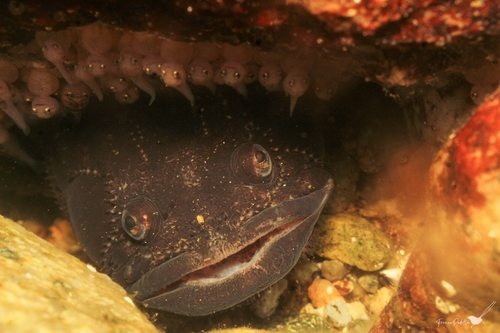
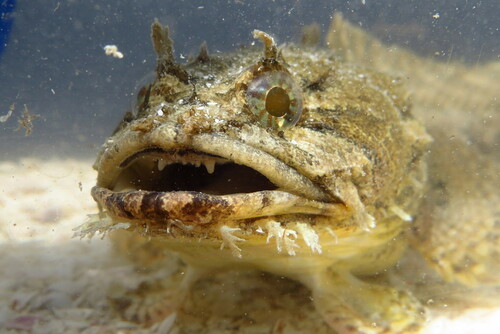
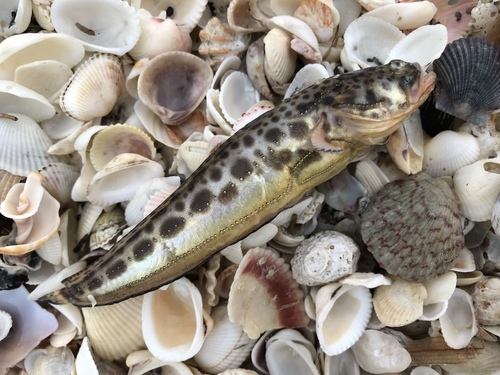
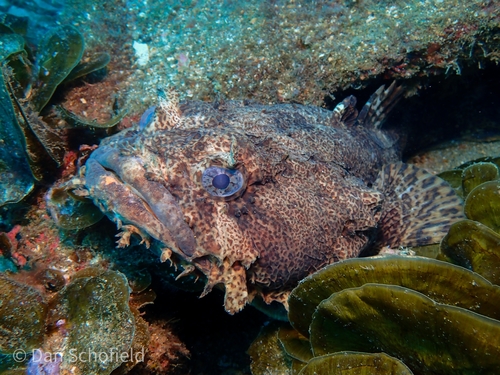
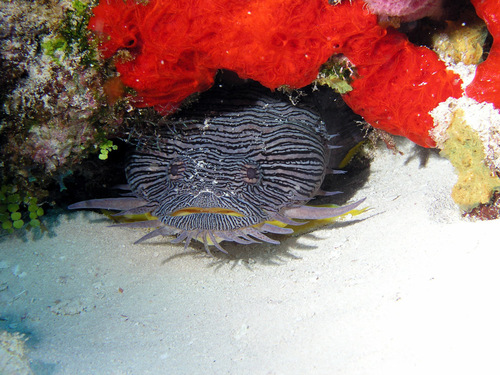
The splendid toadfish, scientifically named Sanopus splendidus, is also commonly known as the coral toadfish and the Cozumel splendid toadfish. This toadfish species was once thought to be entirely endemic to the island of Cozumel, but individuals have now been found across reefs ranging from Honduras all the way north to Cancun. It is commonly found under coral outcroppings, and the dens it creates can be identified by a surrounding sloping sand patch. It is very difficult to encourage this fish to come out into the open. Unlike all other members of the toadfish family, the splendid toadfish is set apart by its vibrant coloration. It has bright yellow fins that carry distinctive patterning, and its head is marked with dark and white stripes. This species has a total of eight fins: two dorsal fins, two pectoral fins, two pelvic fins, one caudal fin, and one anal fin. The two dorsal fins sit along the midline of the fish's upper body. The first is a short fin with sharp spines arranged in three sections, while the second is a long, flowing fin that extends across most of the upper body. Two rounded pectoral fins are located behind the head; they are larger than the two smaller, pointed pelvic fins that sit just forward on the fish's undersurface. On the rear of the undersurface, near the tip of the tail, the splendid toadfish has a small, rounded caudal fin. All of its fins are bordered by bright yellow coloring, with the exception of the pelvic fins. Most core structural features of the splendid toadfish match those of other toadfish family members, including a flat, broadened head and barbells. Like most species that live close to sand, the splendid toadfish has eyes positioned on the top of its head that point directly upward, since it has little need for horizontal vision. Its wide jaws are lined with small, sharp teeth. During mating, the splendid toadfish produces a buzzing call that divers can hear.