About Sander vitreus (Mitchill, 1818)
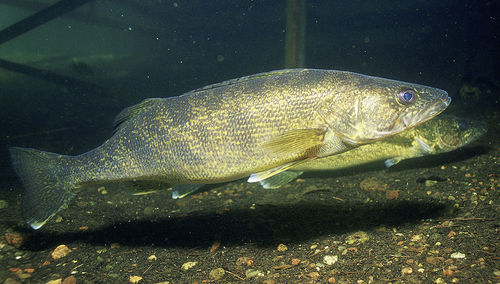
Walleyes (Sander vitreus) are mostly olive and gold in color, which is the origin of their French common name doré, meaning golden. The dorsal (upper) side of a walleye is olive, and this color transitions to a golden hue on the fish’s flanks. The olive and gold base pattern is interrupted by five darker saddle-shaped markings that extend onto the upper sides of the body, and the color fades to white on the belly. Walleyes have a large mouth lined with many sharp teeth. Their first dorsal fin, anal fin, and operculum (gill cover) are all spinous. Walleyes can be distinguished from their close relative the sauger by the white coloring on the lower lobe of the caudal (tail) fin, a feature that is not present on saugers. Additionally, saugers have distinctive rows of black dots on their two dorsal fins and caudal fin, which are absent or indistinct on the same fins of walleyes. Across most of this species’ range, male walleyes reach sexual maturity between 3 and 4 years of age, while females usually mature about one year later. Adult walleyes migrate to tributary streams in late winter or early spring to lay eggs over gravel and rock substrate, though there are also strains that spawn on open-water reefs or shoals. Some populations are known to spawn on sand or vegetation instead. Spawning takes place when water temperatures are between 6 and 10 °C (43 to 50 °F). A large female walleye can lay up to 500,000 eggs, and parents provide no care to eggs or newly hatched fry. The eggs are slightly adhesive and settle into gaps between rocks. The incubation period for walleye embryos depends on water temperature, but generally lasts between 12 and 30 days. After hatching, free-swimming embryos spend around one week absorbing a small amount of yolk. Once the yolk is fully absorbed, young walleyes start feeding on invertebrates such as fly larvae and zooplankton. After 40 to 60 days, juvenile walleyes become piscivorous (fish-eating). From this point onward, both juvenile and adult walleyes eat fish almost exclusively, most often yellow perch or ciscoes, and move to shallow bars and shoals at night to feed. Walleyes also feed heavily on crayfish, minnows, and leeches. The walleye is considered a very palatable freshwater fish, so it is fished both recreationally and commercially for food. Because of its nocturnal feeding habits, it is easiest to catch at night using live minnows or lures that mimic small fish. Most commercial walleye fisheries are located in the Canadian waters of the Great Lakes, and fried walleye is counted as a staple of Canadian cuisine. In Minnesota, walleye are often fished for during late afternoon on windy days (conditions called a "walleye chop") or at night. The fish is very popular in Minnesota, where it is often served as a sandwich in pubs, and deep-fried walleye on a stick is a common food at the Minnesota State Fair. Fried walleye is a popular dish in both Canada and Minnesota.