About Sander canadensis (Griffith & Smith, 1834)
The sauger, with the scientific name Sander canadensis, is a freshwater perciform fish in the family Percidae that closely resembles its close relative, the walleye. It is a member of Perciformes, the largest order of vertebrates, and is the most migratory percid species native to North America.
Saugers have two dorsal fins: the first is spiny, while the posterior dorsal fin has soft rays. Their paired fins are positioned on the thorax, and their caudal fin is truncated, meaning it is squared off at the corners, a trait characteristic of the Percidae family. Like many advanced fishes, saugers have ctenoid scales, and they have a fusiform body structure. This body shape makes them well-adapted as predatory fish, allowing them to swim through fast currents with very little drag on their bodies.
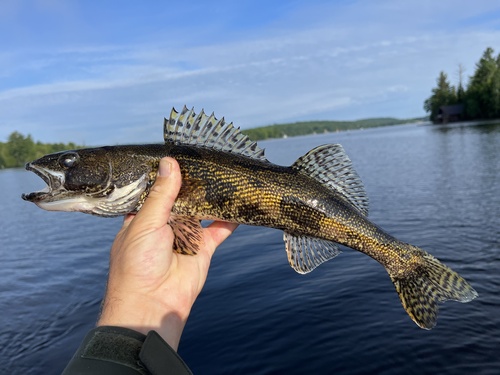
Saugers can be distinguished from walleyes by several key traits: their distinctly spotted dorsal fin, the absence of a white splotch on the caudal fin, the rough skin covering their gills, and their generally more brassy body color, which can be almost black in some regions. A typical adult sauger weighs between 300 and 400 grams (11 to 14 ounces).
Saugers have a wide historical distribution, ranging across the eastern United States west of the Appalachian Mountains, across most of southern, central, and western U.S. states, and extending north into southern Canada. Their current distribution and range have shrunk from historical levels due to degraded and fragmented habitat. Because saugers are migratory, their location within their overall range changes with the time of year. Saugers are most commonly found in rivers, while walleyes are more often found in lakes and reservoirs. Across much of their range, saugers live in sympatry (shared habitat) with walleyes.
Hybridization between saugers and walleyes does occur; the resulting hybrids are called saugeyes, and they show traits from both parent species. Since saugeyes have an appearance intermediate between the two species, they can sometimes be hard to tell apart from pure saugers or walleyes, but they usually carry the dark blotches that are a characteristic trait of saugers. Saugers are usually smaller than walleyes, and tolerate more turbid water than walleyes do. Saugers require summer water temperatures between 20 and 28 °C (68 to 82 °F); this need for warm water is thought to set the northern and western range limits of the species.
Saugers are most often found in large rivers that contain deep pools (with depths greater than 0.6 meters). Their migratory behavior means they encounter a wide variety of different habitats throughout the year. They are most commonly found in unaltered natural rivers, which have more abundant pools and have not had their flow modified by dams or diversions, though they are still common in impounded river systems. Dams and diversions negatively impact the habitat and spawning areas of saugers. Saugers are typically found in areas with high turbidity, low channel slope, low stream velocity, and deep water. They tend to select pools with sand and silt substrates, and habitat features that provide cover from the river current. They generally avoid runs and riffles, and are most commonly found in pools that are at least 1.5 meters deep, though they can be found in shallower pools in lower numbers. No differences in habitat preference between male and female saugers have been observed to date. The number of observed saugers increases with higher mean summer water temperature, greater maximum water depth, and higher water alkalinity.
For reproduction, saugers generally move upstream to spawn between March and May, with spawning timing varying by location. After spawning is complete, they move back downstream to their home habitats between April and July. Saugers have been recorded traveling between 10 and 600 km from their home habitat to their upstream spawning locations. Spawning sites have less complex and less diverse habitats than the home habitats of saugers. Females prefer to deposit their eggs in pools with rocky substrate. As females grow longer, both egg quality and fecundity (egg production) increase, but egg production is thought to decline after females reach 6 years of age.
Saugers reach sexual maturity between 2 and 5 years old, and sexual maturity is also linked to body size. A sauger is considered an adult once it reaches a length of 250 to 300 millimetres (9.8 to 11.8 in). After hatching, larval saugers drift downstream before they develop feeding ability and the capacity for horizontal maneuvering. Juvenile saugers usually develop in diversion canals and backwaters until autumn, when they migrate upstream to their winter habitat. Residing in diversion canals is a major cause of mortality for juvenile saugers.