About Sambucus gaudichaudiana DC.
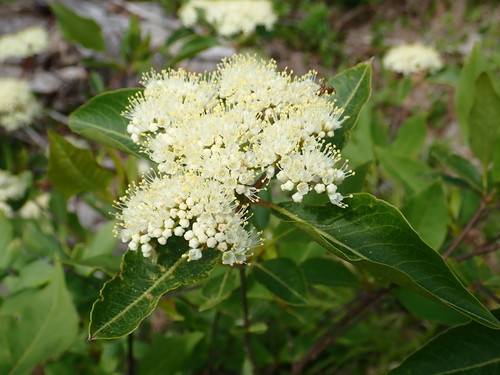
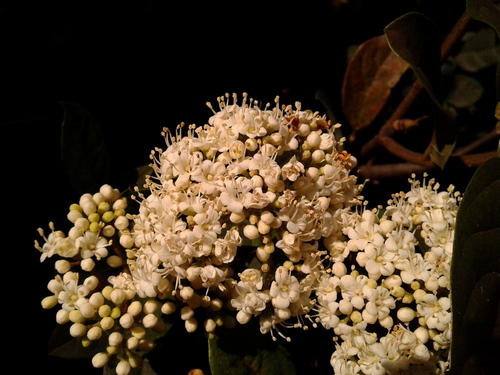
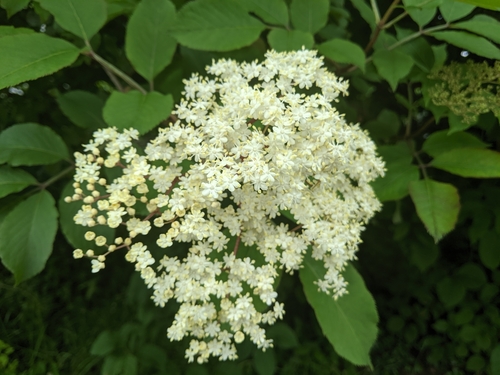
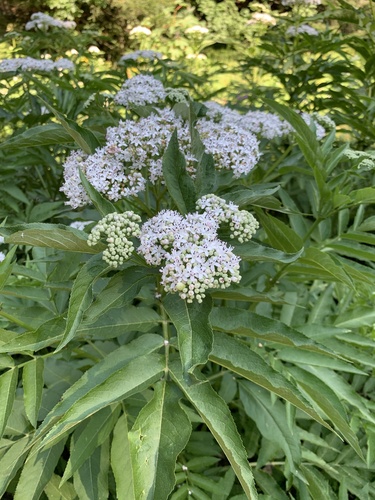
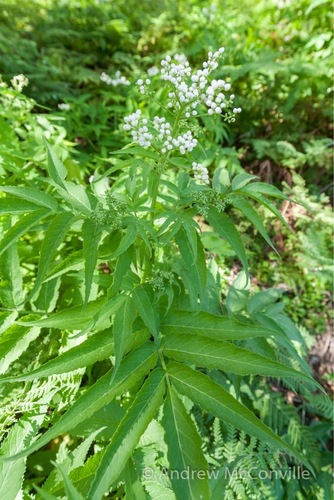
Sambucus gaudichaudiana DC., commonly known as white elderberry, is a shrub that typically reaches a height of 1 to 2 meters (3 feet 3 inches to 6 feet 7 inches). It grows from a perennial rootstock, and produces grooved stems that are renewed every year. Its leaves are pinnate, mostly 100–350 mm (3.9–13.8 in) long and sessile, with between three and eleven narrow lance-shaped to egg-shaped leaflets. The leaflets are mostly 30–50 mm (1.2–2.0 in) long and 10–60 mm (0.39–2.36 in) wide, with serrated or lobed edges. Flowers are borne in corymb-like groups 8–20 mm (0.31–0.79 in) in diameter. Each flower has three or four glabrous, egg-shaped sepals about 1 mm (0.039 in) long, and white petals 2–5 mm (0.079–0.197 in) long. Flowering mainly occurs from October to February. The fruit is an edible, white, oval to spherical drupe about 5 mm (0.20 in) long. This species grows mainly in forest, most often in moist or shady sites. Its range includes south-eastern Queensland, eastern New South Wales extending west to Warren, the Australian Capital Territory, the southern half of Victoria, Tasmania, and the far south-eastern corner of South Australia. The berries of Sambucus gaudichaudiana are edible, juicy, slightly sour, and pleasant tasting. They can be eaten either raw or cooked.