About Sambucus cerulea Raf.
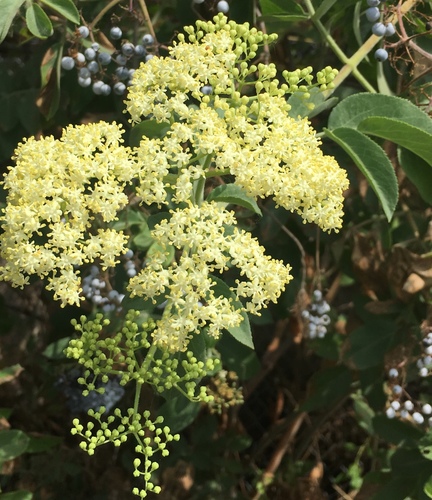
Sambucus cerulea Raf. is a large deciduous shrub that reaches up to 6 metres (20 ft) in both height and width. It typically grows spreading from multiple stems, which can be heavily pruned, or even cut all the way to the ground, during winter dormancy. Its leaves are pinnately divided into 5 to 9 leaflets. Leaflets are usually 3–15 centimetres (1–6 inches) long and 2–6 centimetres (1–2 and 1/2 inches) wide. They have an elliptical to lanceolate shape, with sharp teeth along the edges, and are hairless. The leaf blade extends unevenly along the leaf stalk at the base. White or creamy flowers bloom from May to June; they are numerous and arranged in a flat-topped cluster that is usually 5–20 cm (2–8 in) wide. The clusters are umbel-shaped, typically with 4 to 5 rays extending out from the base. Flowers have a strong, unpleasant odor, and individual flowers are 4–7 millimetres (1/8–1/4 in) wide. Fruits are berry-like drupes. They are juicy, round, and approximately 4–6 mm in diameter. They are bluish-black with a glaucous powder coating that gives them a light blue color, which helps distinguish them from other elderberries. Each fruit contains 3 to 5 small seed-like stones, with one seed enclosed in each stone. Sambucus cerulea is native to Western United States, northwestern Mexico, and British Columbia. Its range extends from the Pacific coasts, through California and the Great Basin, to Montana, Wyoming, Texas and Oklahoma. The species grows at elevations below 3,000 m (9,800 ft), in a diverse range of habitats including mountains and hills, valleys, riparian zones, open areas within woodlands and forests, and exposed slopes where moisture is accessible. The raw berries of this plant contain a toxin that can cause nausea in some people if eaten raw. Flower blossoms can be used to make tea. Fruits can be eaten raw (despite their toxin content), dried, or made into jelly. This taxon is also classified as Sambucus nigra subsp. cerulea, which is cultivated as an ornamental plant by plant nurseries for use in traditional gardens, native plant gardens, and habitat gardens. It is also used for natural landscaping and habitat restoration projects. When trained from youth to retain only several dominant trunks, it can grow into a multi-trunk tree. It is a useful plant for wildlife gardens: its flowers attract pollinators, butterflies, and hummingbirds, while its berries feed various bird species and chipmunks.