About Sambucus canadensis L.
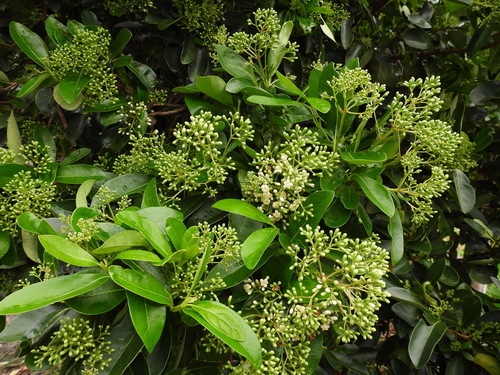
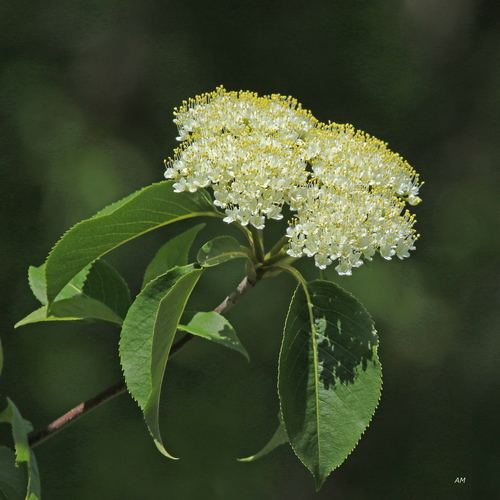
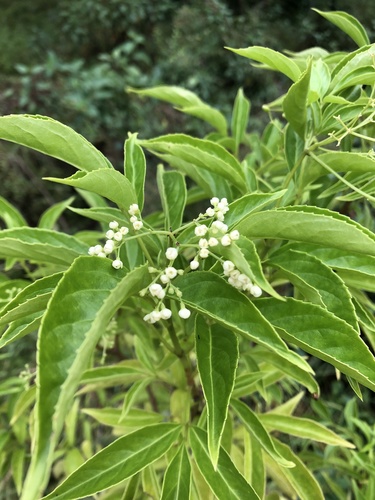
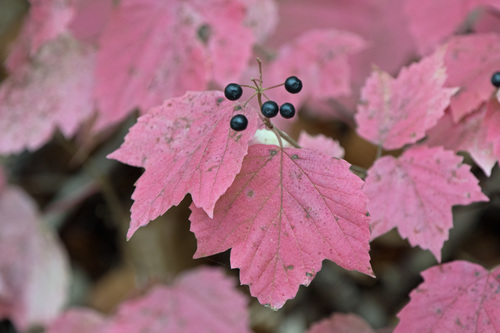
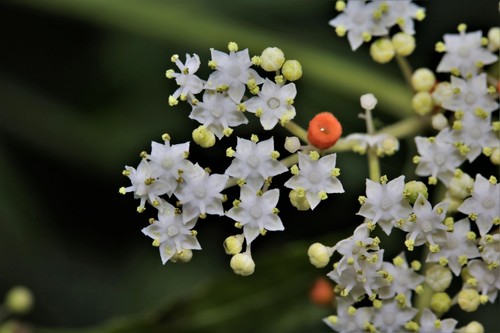
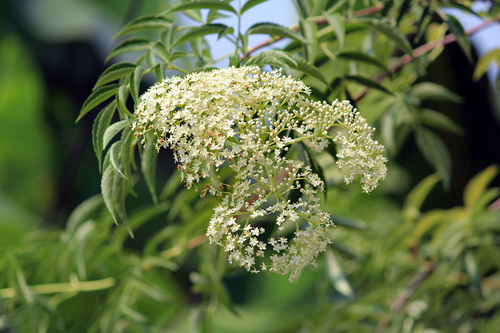
Sambucus canadensis L., commonly known as American elderberry, is a deciduous suckering shrub that can grow up to 6 metres (20 feet) tall. Its leaves are arranged in opposite pairs, and are pinnate with 5 to 9 leaflets. Each leaflet measures roughly 10 centimetres (4 inches) long and 5 centimetres broad. In summer, the shrub produces large corymbs of white flowers that sit above the foliage; these corymbs are 20–30 cm (8–12 in) in diameter, while individual flowers are 5–6 millimetres (3⁄16–1⁄4 in) across and have five petals. The fruit, called elderberry, is a dark purple to black berry 3–5 mm in diameter, and grows in drooping clusters in the fall. This species is native to a large area of North America east of the Rocky Mountains, and ranges south through mainland Americas all the way to Bolivia. It is classified as an introduced species in the Caribbean, Europe, Africa, and Asia. It can grow in a wide range of conditions, including both wet and dry soils, and grows primarily in sunny locations. Its most common habitat types include marshes, swamps, and open woodland floodplains, among other areas. Inedible parts of the plant, including the leaves, stems, roots, seeds, and unripe fruits, can be toxic because they contain cyanogenic glycosides and alkaloids. Traditional preparations that consume this elderberry include jams, jellies, and syrups, all of which involve cooking the fruit and straining out the seeds. Unpublished research suggests that S. canadensis may have lower cyanide levels than apple juice, and that its fruit does not contain enough beta-glucosidase, the enzyme that converts glucosides into cyanide, to produce cyanide through this biochemical pathway. As a comparison, for S. nigra which contains no more than 25 micrograms of cyanogenic glycosides per milligram of berry weight: if all glycosides were converted to cyanide, and assuming a lethal dose of 50 mg cyanide for a 50 kg vertebrate, one would need to eat 2 kilograms (~4.4 pounds) of berries in a single sitting to reach the lower limit of lethal toxicity (1 mg cyanide per kg of body weight). For the upper lethal limit (3 mg cyanide per kg of body weight), one would need to eat 6 kg (~13 pounds) of berries in one sitting. The flowers (called elderflower) and ripe berries are edible, though cooking is generally recommended to reduce intake of the glycosides linked to potential toxicity. A drink can be made by soaking elderflower heads in water for eight hours. Ripe fruit is also used to make wine, jelly, and dye. The leaves and inner bark can be used as an insecticide and a dye. The genus name Sambucus comes from the Greek word sambuce, an ancient wind instrument, referring to the practice of removing pith from the twigs of this and other related species to make whistles. The Iroquois people of North America used boiled elderberry inner bark as a pain reliever for toothaches, applying it to the side of the cheek where pain was most severe.