About Samanea saman (Jacq.) Merr.
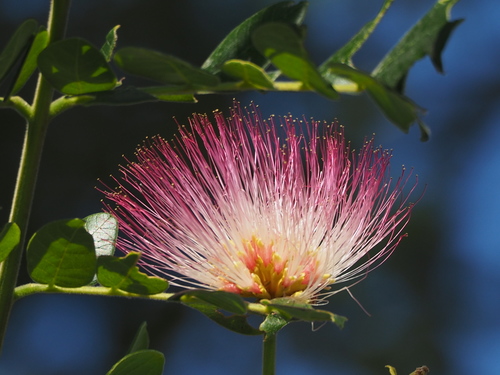
Samanea saman (Jacq.) Merr. is a semi-deciduous flowering tree species belonging to the pea family Fabaceae, currently grouped in the Mimosoid clade, and it is native to Central and South America. This species is most often classified in the genus Samanea, though some other authors fully subsume the genus Samanea into Albizia. Its native range stretches from Mexico southward to Peru and Brazil, but it has been widely introduced to South Asia, Southeast Asia, and Pacific Islands including Hawaii. It is a well-known tree; among trees in its genus, only lebbeck and pink siris are similarly well-known. It is referenced in many languages and has many local names across its native range; common English names for the species are saman, rain tree, and monkeypod. In Cambodia, it is colloquially called the Chankiri Tree, which can be written as ចន្ទគិរី or ចន្ទ៍គីរី. The edible fruit pulp of Samanea saman can be made into a beverage with a lemon-like flavor, and this pulp is also used as an additive for gasoline. The tree’s wood has high chatoyance, and it is used for carving and manufacturing furniture. Samanea saman is one of several host plant species that support infestations of lac insects (Kerria lacca). These insects cause the tree to produce copious sap or insect discharge, which hardens into a material that is then collected and processed into lac or shellac, used to make lacquerware and wood finishes.