About Samadera indica Gaertn.
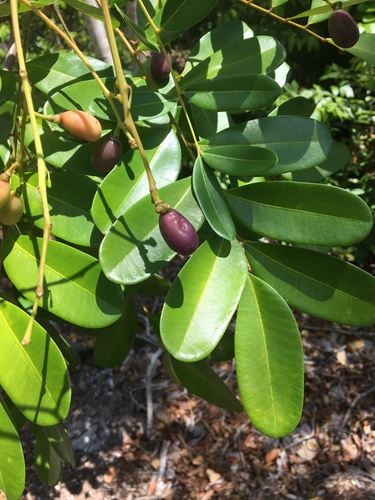
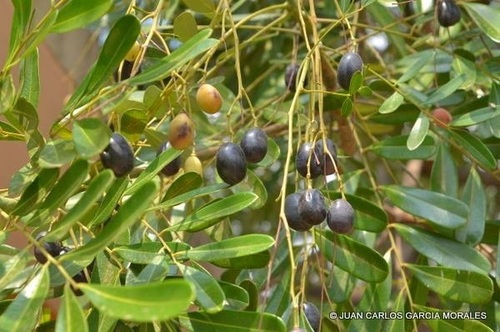
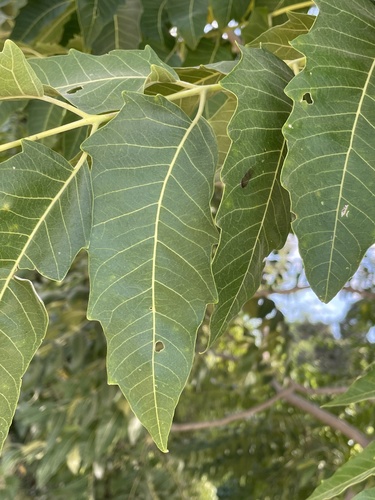
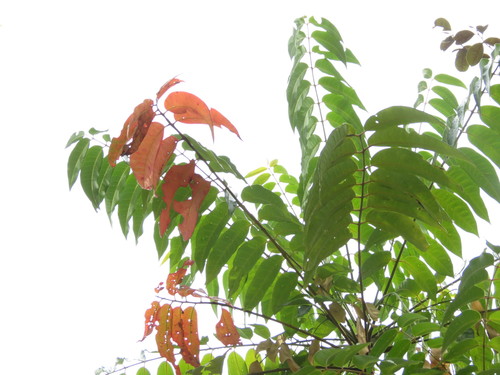
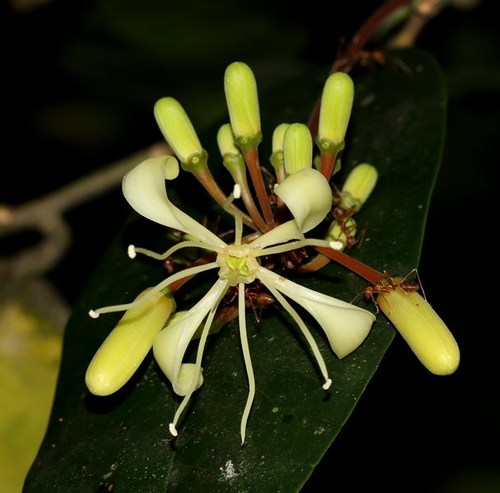
Samadera indica Gaertn. is an evergreen tree or shrub that can reach heights of 10 m (32.8 ft) to 20 m (65.6 ft). It has pale yellow, transversely cracked bark with small pores. It lacks heartwood, and its medullary rays are very fine, uniform, and closely packed. Branches are stout and glabrous (hairless). Leaves are simple, elliptic, ovate, or obovate, measuring 5–25 cm long and 2–8.5 cm wide. Leaf apexes are rounded to acuminate, bases are rounded or obtuse; leaves are glabrous, glandular on the lower surface, and have dense reticulate veining. Petioles are 7–15 (up to 30) mm long, stout, and often curved. Flowers are bisexual, and typically appear in groups of 20 or more in umbelliform, glabrous or puberulous inflorescences. Peduncles are 7–30 cm long, stout, flat, and thickened toward the top; pedicels are 1 to 3 cm long, jointed at the base, with minute bracts. The calyx is 4-lobed; there are 4 petals, each 0.5 cm long, that can be white, pale yellow, or purplish. This species flowers year-round. Fruits develop from 1–4 carpels, each forming a woody drupe. Drupes occur in groups of 1 to 4, are ellipsoid, flattened, smooth, glandular, and reticulate, with a thin unilateral wing on the upper part. They measure 4–6 cm long, 2.5–3.7 cm wide, and 1.3–1.9 cm thick, each holding one large, brown seed. Fruits are green blotched with red and ovoid, grouped in sets of 1-4 carpels. Seeds have a thin testa, lack endosperm, have plano-convex cotyledons, and reach up to 3.5 cm by 2.5 cm in size.
This species is native to Africa (Tanzania, Pemba Island, Comoros, Madagascar), tropical Asia (India, Bangladesh, Sri Lanka), Indo-China (Andaman Islands, Cambodia, Laos, Myanmar, Vietnam), Indonesia, Malesia (Borneo, Malaya, Philippines, Sulawesi, Sumatra), Papuasia (Bismarck Archipelago, New Guinea, Solomon Islands), Pacific islands (Caroline Islands, Vanuatu), and the island of Singapore. It is not found on Java or the Lesser Sunda Islands.
It grows in low-altitude forests, including moist deciduous forests, evergreen forests, mixed dipterocarp forests, backwaters, peat-based tidal swamp forests, periodically inundated forests, and along river shores. In India, it is most often found in the evergreen forests of the Western Ghats mountain range. In Singapore, it occurs in tidal swamp forests and on the edge of mangrove forests. It grows at altitudes up to 150–200 m (490–660 ft) above sea level, and can grow on alluvial sites with sandy soil as well as on limestone.
It can be cultivated in parks or gardens for its attractive foliage, fruits, and overall form. It grows in well-drained soils and tolerates moist soils, thrives in full sun, requires the same general watering as any other shrub, and can be propagated by seed.
Parts of this tree are harvested from the wild for use in local traditional folk medicine across several countries. Traditional and studied medicinal properties include analgesic, anti-inflammatory, antifeedant, antimicrobial, anti-tumor, phytotoxic, antiviral, anthelmintic, anti-malarial, growth regulating, and antioxidant activities. In Congo and Madagascar, it is used to treat malaria. In Sri Lanka, a mixture of powdered bark or wood scrapings in warm water or coconut oil is used to treat fever; roasted pounded seeds are applied to areas affected by rheumatism; bruised leaves are applied to skin eruptions; and seeds are worn around the neck to help prevent asthma. In the Ayurvedic health system, the drug Guchakaranja is derived from this species, which is called Karinjotta in Kerala, India. In India, it is used to address conditions linked to vata and kapha, including arthritis, constipation, and skin diseases such as leprosy, scabies, pruritus, and erysipelas. The bark is also used to treat fevers in India; seed oil is applied externally as a liniment for rheumatic joints and bruises. It is recognized as a medicinal plant in Myanmar. In Burma and Indonesia, seeds are used externally to treat rheumatism. In Indonesia, bark, wood, and seeds act as a febrifuge (fever-reducing substance) and tonic, and a decoction is prescribed for bilious fever. Chewed or ground with water, seeds act as an emetic and purgative, and seed oil is an ingredient in an embrocation for rheumatism. Crushed leaves are applied to treat erysipelas, a skin infection. In the Philippines, bark and wood macerated in water, alcohol, or wine are credited with tonic, stomachic, anticholeric, antifebrile, and emmenagogue properties (to stimulate blood flow in the pelvic area and uterus). Juice from pounded bark treats skin diseases, and scraped or powdered bark mixed with water or oil is given to treat "malignant fever". In the Solomon Islands, water from macerated bark is drunk to relieve constipation; macerated leaves mixed with coconut oil are applied to the hair to kill lice; and a seed infusion is used as an antipyretic.
This plant is also used to produce insecticides. An infusion or decoction of leaves is used to kill termites (white ants), particularly in Congo and Madagascar. Leaf extracts have been shown to significantly reduce the reproduction ability and egg hatchability of the mosquito species Culex quinquefasciatus, Anopheles stephensi, and Aedes aegypti.
Other uses include mixing macerated leaves with coconut oil to apply to hair for cleansing. The pale yellow wood is light and soft; in Sarawak, Malaysia, it is used locally to make knife handles, such as handles for parangs. Seeds contain approximately 33% oil, but obtaining a sufficient commercial supply of this oil is thought to be difficult. It is used as an ornamental plant, and is planted in parks and gardens in Singapore, and also cultivated in Myanmar.