About Salvinia natans (L.) All.
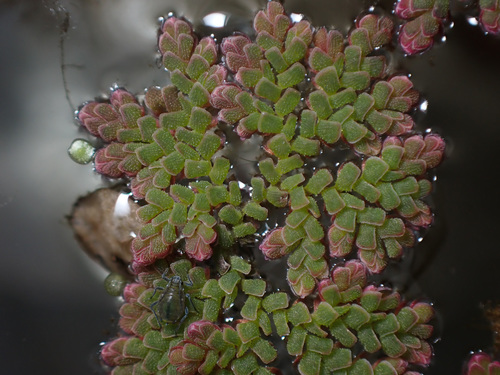
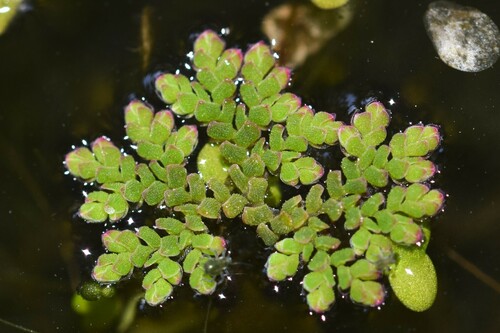
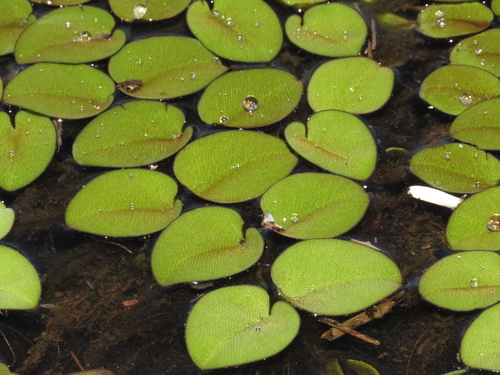
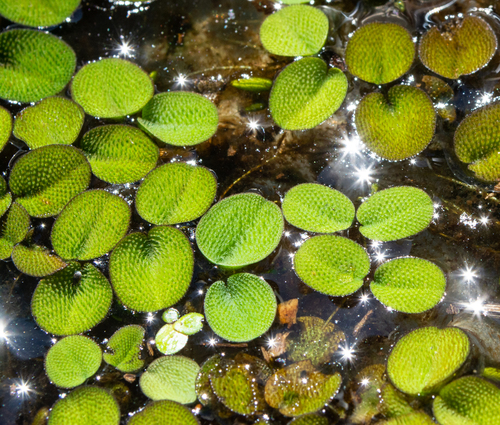
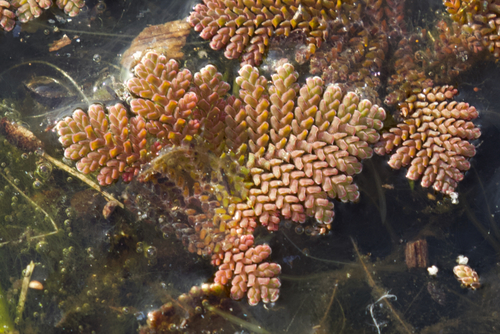
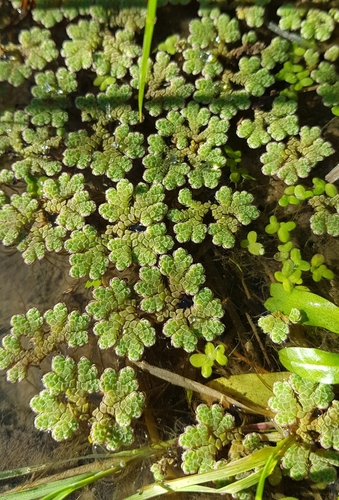
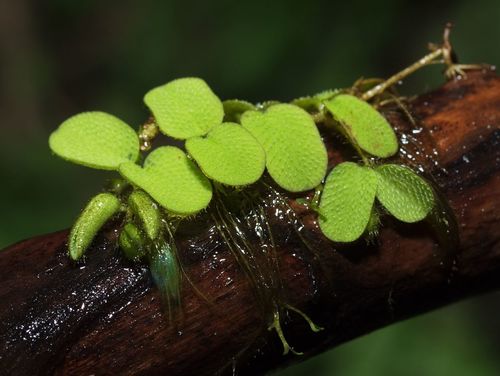
Salvinia natans (L.) All. has three leaves total: two nickel-sized leaves that lie flat on the water surface, and a third submerged leaf that acts as a root. Air pouches within the leaves allow the plant to float. Cuticular papillae on the leaf surface prevent water from disrupting leaf function and also protect the leaves from decay. Reproductive spore cases develop at the base of the plant. The floating leaves of S. natans block sunlight from penetrating deep underwater. This shading creates safe hiding places for breeding that benefit many freshwater fish, but it can interfere with photosynthesis in submerged aquatic plants. Without ecological competition, S. natans can eventually grow to completely cover entire ponds or lakes, outcompeting and starving other native plant species. Salvinia natans is native to multiple continents across a wide distribution range. In Africa, it is native to Algeria, Egypt, Libya, Morocco, and Tunisia. In Asia, it is native to Afghanistan, Azerbaijan, China, Cyprus, India, Indonesia, Iran, Iraq, Israel, Jordan, Kazakhstan, Lebanon, northwest Pakistan, the Russian Federation, Japan, Korea, Saudi Arabia, Syria, Taiwan, Thailand, Turkey, and Uzbekistan. In Europe, it is native to Belarus, Belgium, Bulgaria, Czech Republic, France, Germany, Hungary, Italy, Moldova, the Netherlands, Poland, Romania, the southern European part of the Russian Federation, Slovakia, Spain, Ukraine, and all states that were formerly part of Yugoslavia. Data from archaeological sites and pollen cores confirms that S. natans was already common in the Rhine/Meuse delta of the Netherlands during the Middle Holocene.