About Salvinia minima Baker
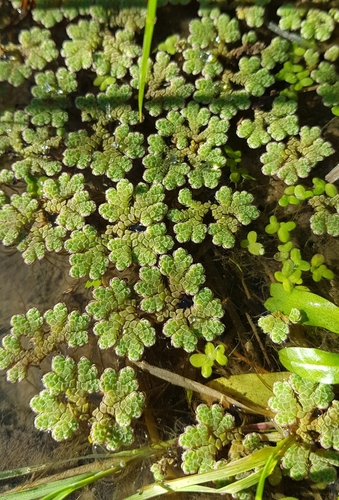
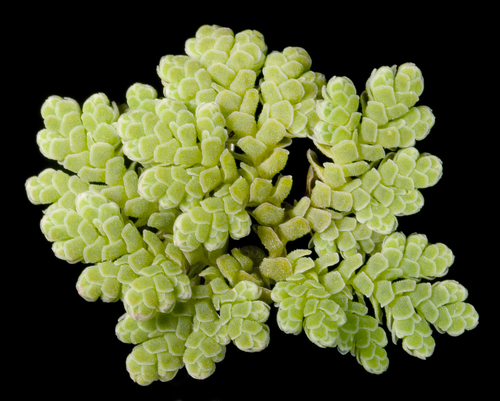
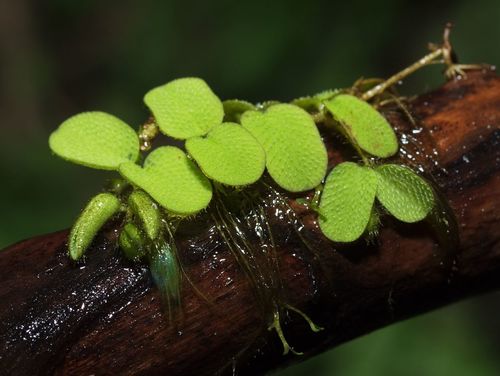
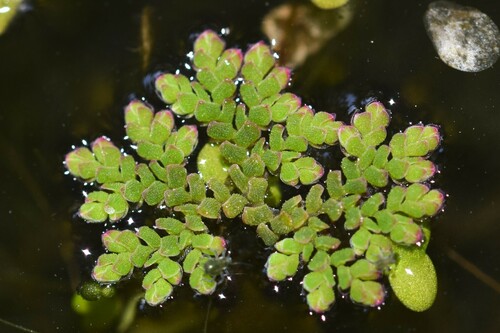
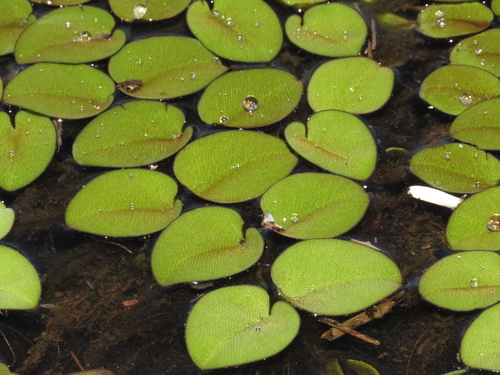
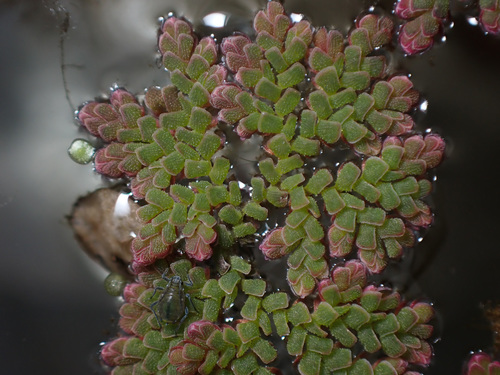
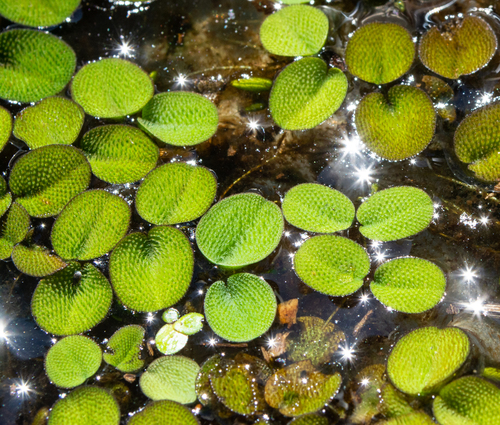
Salvinia minima Baker is a rootless floating fern. Its leaves are small and oval, ranging from 0.4 to 2 centimeters in length, and vary in color from bright green to brown, often turning brown as they age and when exposed to sunlight. Each floating rhizome sits close to the water surface, with horizontally branching leaves that grow in joined sets of three: two leaves float on the water surface, and one dissected leaf hangs underneath. This hanging dissected leaf acts as a root-like structure, and it is longer than the floating leaves. Fine white hairs grow uniformly across the leaf surface to repel water; these hairs grow in groups of four that do not touch at the tips. Longer brown hairs are also present on the underside of the leaves. Salvinia minima most commonly grows on the surface of still or slow-moving freshwater areas, including lakes, ponds, and canals. It can tolerate water salinity up to 4 to 7 parts per thousand (equal to 1.003–1.005 specific gravity), so it also grows in brackish water habitats such as swamps, marshes, and wetlands. It can also be found in backyard ponds and private lakes, and is available for purchase in U.S. states where it is not prohibited as a noxious plant. Salvinia minima reproduces asexually only through fragmentation. While sporocarps (spore-producing sacs) may sometimes be present on its leaves, the species is thought to be sterile. Any rhizome fragment that buds or breaks off can develop into a new separate daughter plant. Because fragmentation can happen continuously, Salvinia minima often grows exponentially. Buds and rhizome fragments can also stay dormant for periods when growing conditions are unfavorable.