About Salvia yangii B.T.Drew
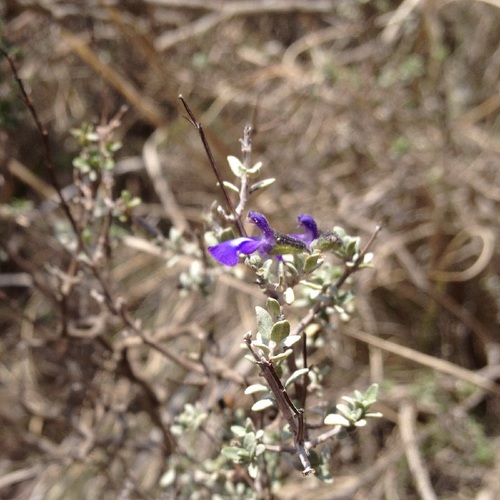
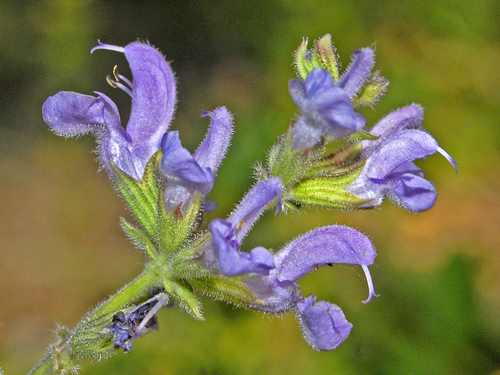
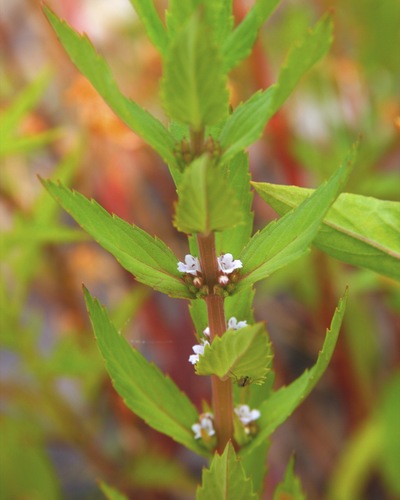
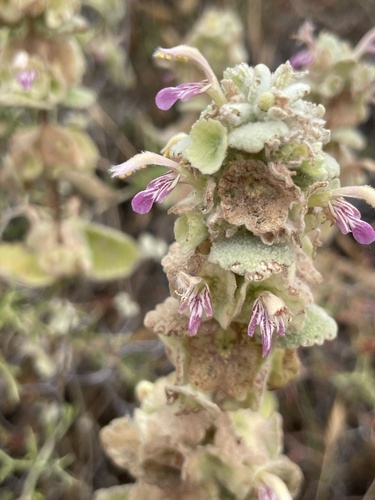
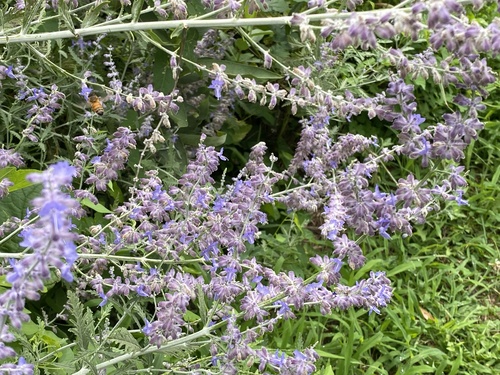
Salvia yangii B.T.Drew is a deciduous perennial subshrub with an erect to spreading growth habit, and superficially resembles a much larger form of lavender. Multiple branches grow from a shared rootstalk, reaching 0.5–1.2 metres (1+1⁄2–4 feet) in height, with occasional individual plants growing as tall as 1.5 m (5 ft). Mature plants typically spread 0.6–1.2 m (2–4 ft) across. Its rigid stems have a square cross-section, and are covered in an indumentum made of star-shaped (stellate) trichomes and oil droplets. These hairs give the stems a silvery appearance, especially in autumn. Its grayish-green leaves grow in opposite pairs, attached to stems by a short petiole. Leaves are usually 3–5 centimetres (1+1⁄4–2 inches) long and 0.8–2 cm (1⁄4–3⁄4 in) wide, though they are narrower in some populations. Overall leaf shape ranges from oblate (a rounded shape longer than it is wide) to lanceolate (shaped like a lance head). Leaves are pinnatipartite, with a deeply incised margin that can be either wavy or sharp-toothed; considerable variation in leaf shape details can occur even within a single population of S. yangii. Leaves near the top of branches may merge into bracts. The foliage is aromatic, particularly when crushed, with a fragrance described as sage-like, a blend of sage and lavender, or similar to turpentine. The flowering season of S. yangii can last as long as June through October, though populations in some parts of its range (such as China) may have a much more restricted blooming period. Its inflorescence is a showy panicle 30–38 cm (12–15 in) long with many branches. Each of these branches is a raceme, with individual flowers arranged in pairs called verticillasters. Each flower has a purple calyx, densely covered in white or purple hairs, that measures about 4 millimetres (1⁄8 in) long. The corolla is tube-shaped, formed by a four-lobed upper lip and a slightly shorter lower lip; the blue or violet blue petals are approximately 1 cm long. The style has been recorded in two forms: one exserted, meaning it extends beyond the flower's tube, and one contained entirely within the flower. All known cultivated examples of S. yangii have exserted styles. Gardening writer Neil Soderstrom describes the appearance of the flowers from a distance as "like a fine haze or fog". Fruits develop roughly one month after flowering, and are dark brown oval nutlets measuring about 2 mm × 1 mm (2⁄25 in × 1⁄25 in). In its native range, S. yangii is widely distributed across Asia, growing in western China, northwestern India, Pakistan, Afghanistan, Iran, Turkey, and parts of eastern Europe. It grows in steppes and on hillsides, and occurs at higher elevations in mountainous regions, including the Himalayas. It has been recorded at 3,000 m (10,000 ft) of altitude in the Karakoram. In Pakistan's Quetta district, it often grows alongside the grass Chrysopogon aucheri, and may act as an indicator species for soils with low availability of calcium carbonate and chloride. The harsh habitats that S. yangii prefers are comparable to the sagebrush steppe of North America. In parts of its range such as the Harboi, these steppe ecosystems are used as rangeland for grazing animals including sheep and goats, though the forage here is generally of poor nutritional quality. S. yangii can be an important source of phosphorus and zinc, despite being high in poorly digested materials such as neutral detergent fiber and lignin. After S. yangii was introduced to the United Kingdom in 1904, Irish gardener and author William Robinson quickly became fond of the plant, describing it as "worth a place in the choicest garden for its graceful habit and long season of beauty." The Royal Horticultural Society records that cultivar development began with P. 'Hybrida', selected at a Hampshire nursery in the 1930s. By the late 1980s and early 1990s, S. yangii had become widely popular, and in 1995 it was selected as the Perennial Plant Association's Plant of the Year. The cultivar 'Blue Spire' has earned the Royal Horticultural Society's Award of Garden Merit. Commonly known as Russian sage, this species has a long history of use in traditional medicine, and is smoked as a euphoriant. Beyond its use in folk medicine, it is sometimes used in Russia to flavor a vodka-based cocktail. Its flowers are eaten in parts of Afghanistan and Pakistan, including Kashmir, where they add a sweet flavor to salads. This species is considered a candidate for use in phytoremediation due to its rapid growth, tolerance of harsh conditions, and ability to accumulate toxic heavy metals from polluted soil. Its essential oil can act as a biopesticide, particularly effective against Tropidion castaneum beetles and Camponotus maculatus carpenter ants.