About Salvia pratensis L.
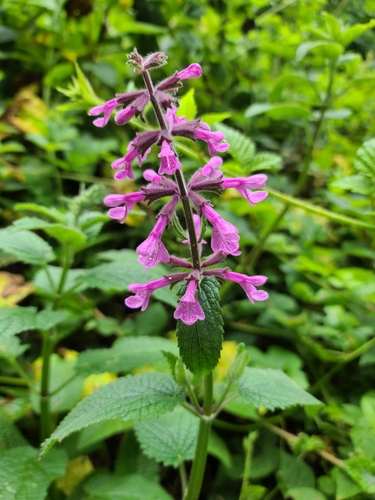
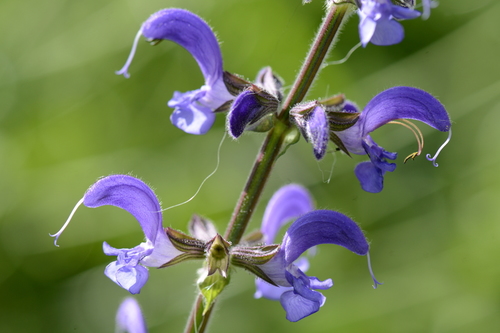
Salvia pratensis L. is a herbaceous perennial that grows as a basal clump between 1 and 1.5 meters (3.3 to 4.9 feet) tall. It has rich green, rugose leaves that are slightly ruffled with toothed edges. Its four-angled stems are covered in soft, glandular hairs, and leaves are arranged in opposite pairs. Lower stem leaves reach up to 15 cm (6 in) long, and decrease in size further up the stem. Flower stalks are typically branched, with four to six flowers per verticil forming a lax spike. The whole inflorescence can grow up to 30.5 cm (12 in) long, and flowers open starting from the base of the inflorescence, with individual flowers reaching up to 2.5 cm (1 in) long. The small calyx is dark brown. The corolla is irregular, 20 to 30 mm (0.8 to 1.2 in) long, fused into a long tube with two lips. The upper lip curves into a crescent shape, while the three-lobed lower lip has a larger central lobe than its lateral lobes. In wild populations, the corolla is most often bluish-violet. Cultivated plants produce flowers in a wide range of colors, including rich violet, violet-blue, bluish white, pink, and pure white. Two long stamens are protected by the upper corolla lip, and the fruit is a four-chambered schizocarp. This species is native to Europe, western Asia, and northern Africa, where it grows in meadows, fields, banks, and rough areas. It has become naturalized across many parts of the United States, and is classified as a noxious weed in the state of Washington. It was once banned in California, because it was believed to have naturalized in three locations there. Salvia pratensis is hardy even in the coldest European climates, surviving temperatures as low as −40 °C (−40 °F). It is widely grown in horticulture, particularly Salvia pratensis subsp. haematodes, which is valued by flower arrangers for use as a cut flower. Some botanists classify this taxon as a separate species, Salvia haematodes. Named cultivars of the species include 'Atroviolacea' with dark blue to violet flowers, 'Baumgartenii' with blue to violet flowers, 'Lupinoides' that grows to 60 cm (24 in) tall and has white-flecked blue to purple flowers, 'Mitsommer' ('Midsummer') with sky blue flowers, 'Rosea' with rose-pink to purple flowers, 'Rubicunda' with rose-red flowers, 'Tenorii' that grows to about 60 cm (24 in) tall and has blue flowers, and 'Variegata' with blue flowers that sometimes have white tips. The common name 'clary' for this plant comes from 'clear-eye', and historically its seeds were ground into a paste used to clear eye irritations. It was also used for gargling, as an early form of toothpaste, and as a flavoring for alcoholic drinks.